Medium-Voltage Power Equipment Market Size & Share Analysis - Growth Trends and Forecast (2026 - 2031)
Medium-Voltage Power Equipment Market Size & Share Analysis - Growth Trends and Forecast (2026 - 2031)
Industry: Smart Grid & Power Infrastructure (Energy & Power)
Source: https://www.mordorintelligence.com/industry-reports/medium-voltage-power-equipment-market
Scraped Date: 2026-09-17
Key Market Estimates
| Variable | Value | Unit |
|---|
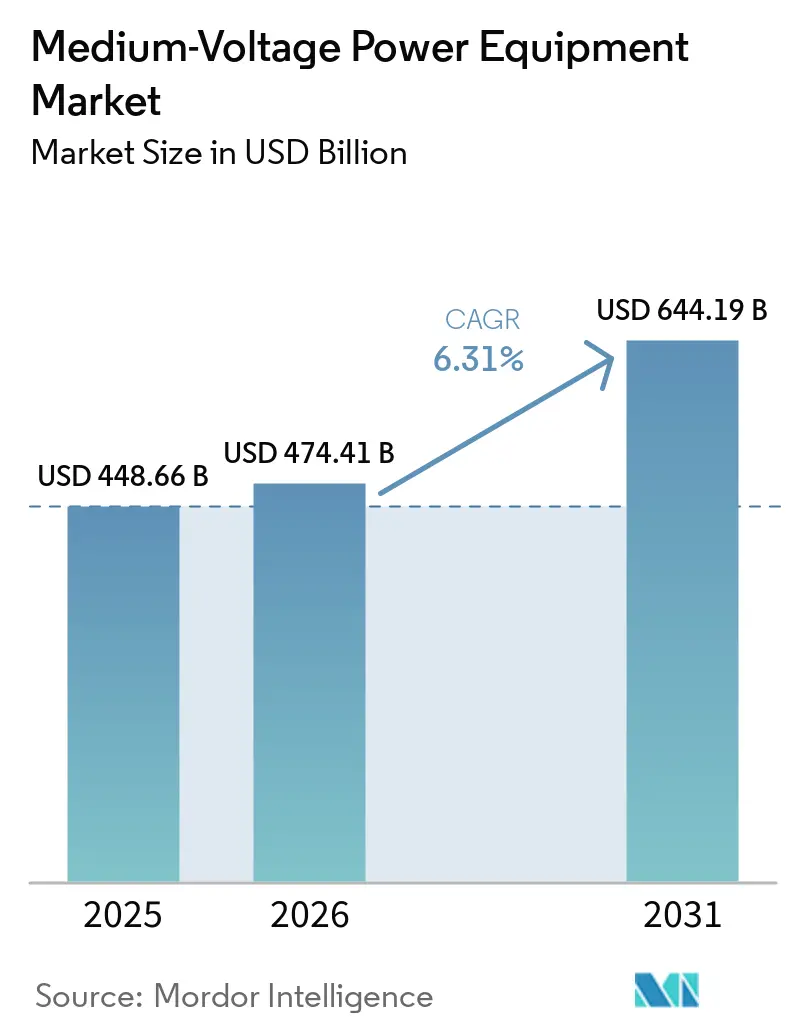
| Market Size (2026) | 474.41 | USD Billion |
|---|
| Market Size (2031) | 644.19 | USD Billion |
|---|
| Growth Rate (2026 - 2031) | 6.31 | PERCENT |
|---|
| Fastest Growing Market | Asia-Pacific |
|---|
| Largest Market | Asia-Pacific |
|---|
| Market Concentration | Medium |
|---|



Section 1
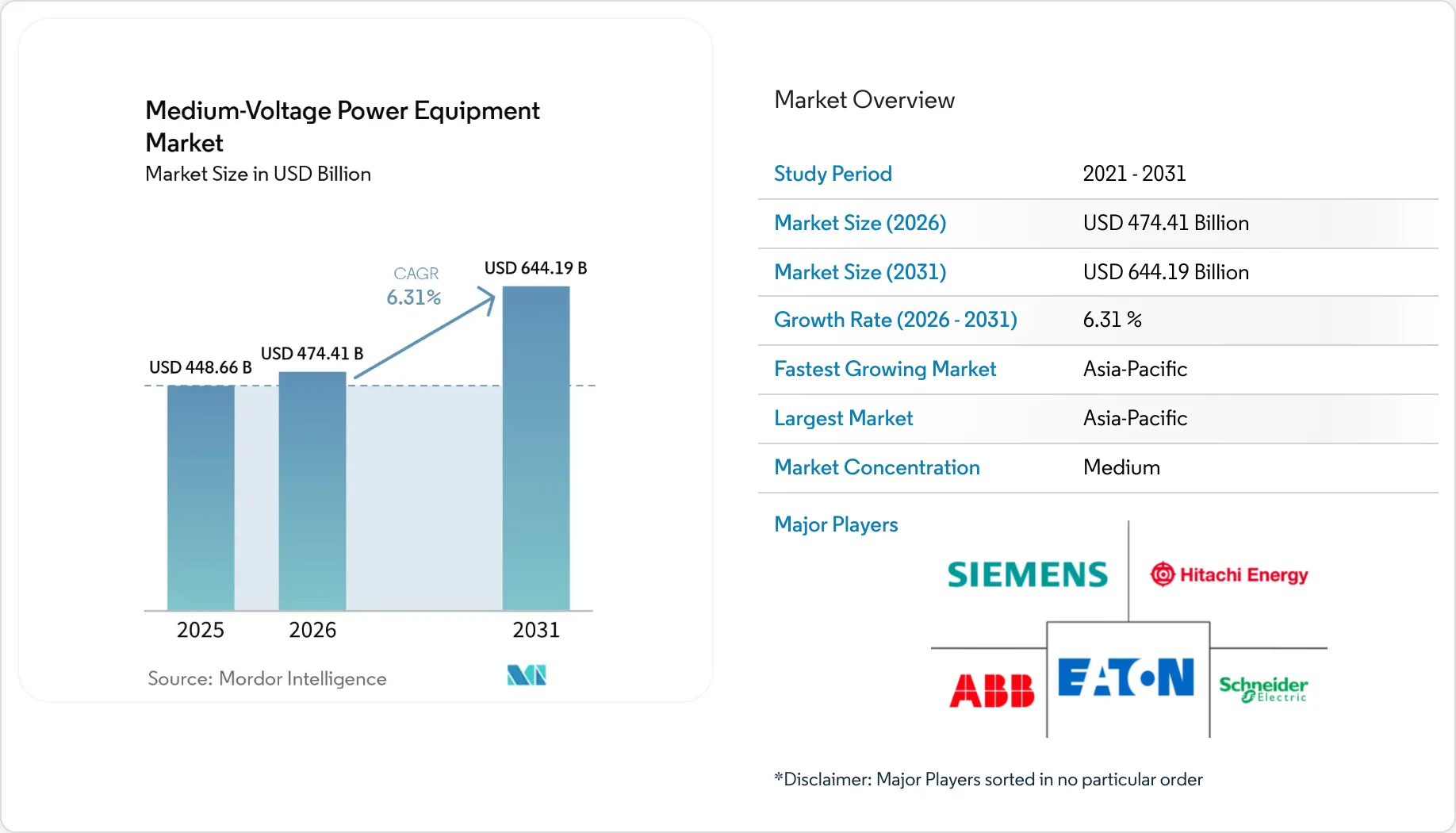
Medium-Voltage Power Equipment Market Size and ShareMarket OverviewStudy Period | 2021 - 2031 |
Market Size (2026) | USD 474.41 Billion |
Market Size (2031) | USD 644.19 Billion |
Growth Rate (2026 - 2031) | 6.31 % |
Fastest Growing Market | Asia-Pacific |
Largest Market | Asia-Pacific |
Market Concentration | Medium |
Major Players*Disclaimer: Major Players sorted in no particular order
Image © Vijeron Intelligence. Reuse requires attribution under CC BY 4.0.
Image © Vijeron Intelligence. Reuse requires attribution under CC BY 4.0.
Section 2
Medium-Voltage Power Equipment Market Analysis by Vijeron IntelligenceThe Medium-Voltage Power Equipment Market size is expected to grow from USD 448.66 billion in 2025 to USD 474.41 billion in 2026 and is forecast to reach USD 644.19 billion by 2031 at 6.31% CAGR over 2026-2031. Grid investment is increasing across established networks in North America and Europe, while electrification programs are raising equipment demand in South and Southeast Asia. Replacement programs now address capacity, reliability, digital control, and resilience at the same time. Data centers, renewable plants, and new industrial loads are concentrating demand at locations that need transformers, switchgear, protection systems, and distribution equipment. Long equipment delivery schedules are shifting purchasing decisions toward framework agreements, dual sourcing, and earlier supplier engagement. These conditions support capacity additions by manufacturers while increasing the value placed on qualified local production and integrated equipment packages.
Key Report Takeaways* By equipment type, Other Equipment held 54.8% of the medium-voltage power equipment market share in 2025, while Generators are expected to grow at a 8.6% CAGR through 2031.
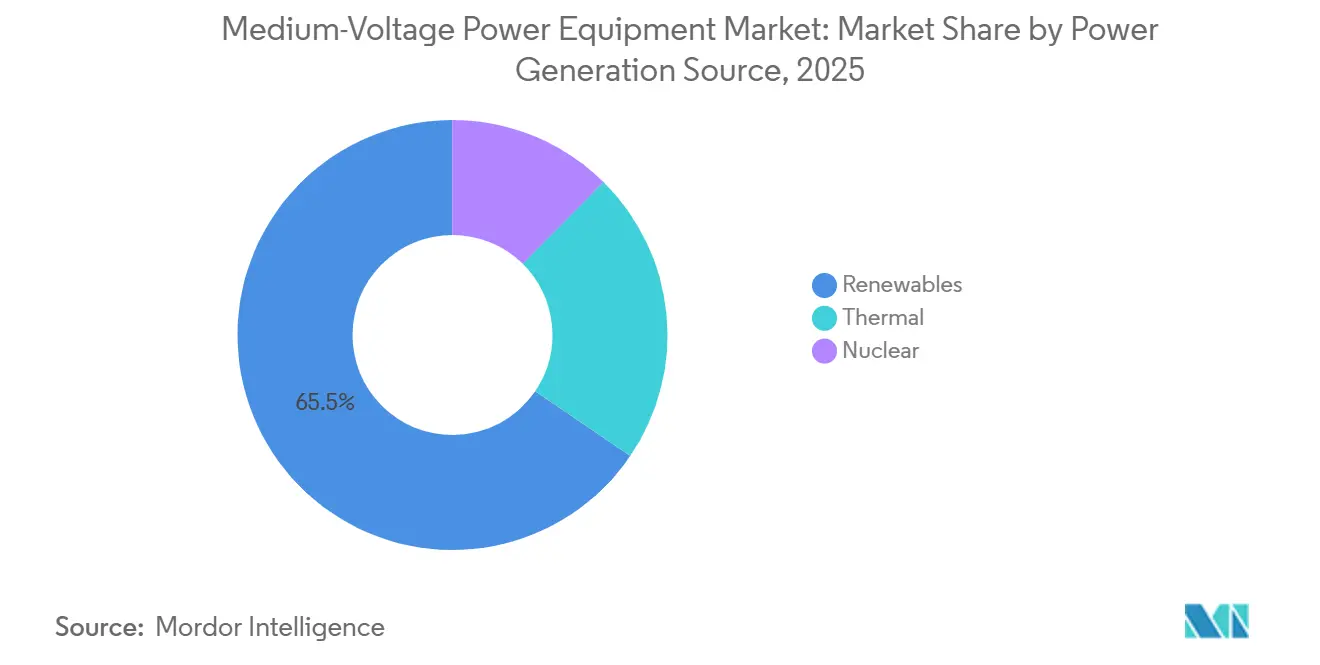
- By power generation source, Renewables accounted for 65.5% of the medium-voltage power equipment market size in 2025 and are projected to expand at a 6.8% CAGR through 2031.
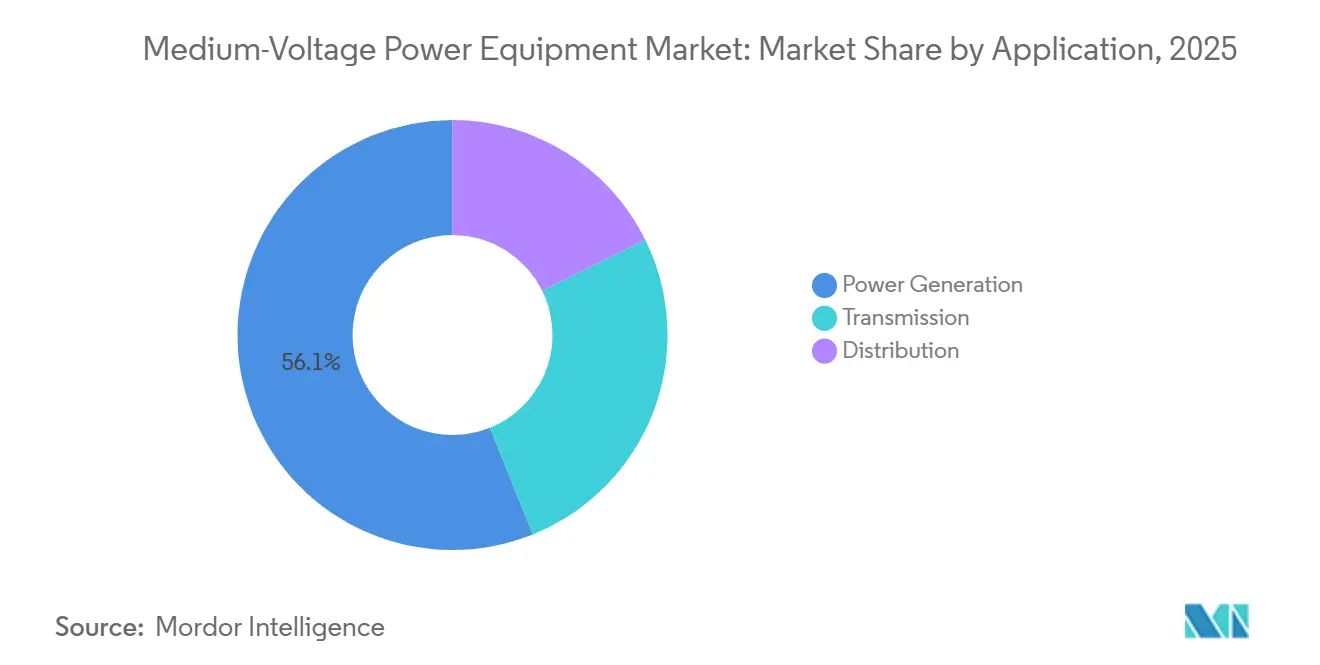
- By application, Power Generation captured 56.1% of revenue in 2025, while Transmission is forecast to grow at a 7.7% CAGR through 2031.
- By end user, Utilities held 59.2% of revenue in 2025, while Residential is forecast to grow at a 7.5% CAGR through 2031.
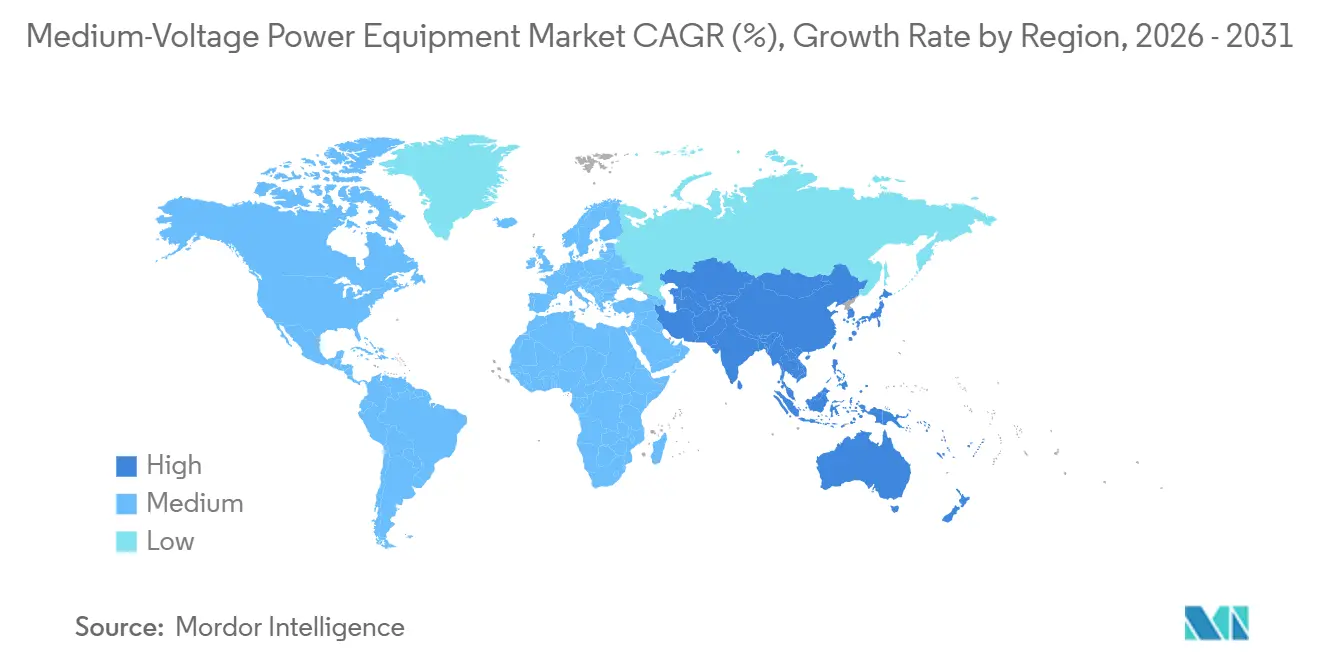
- By geography, Asia-Pacific held 49.8% of revenue in 2025 and is forecast to grow at a 7.1% CAGR through 2031.
Note: Market size and forecast figures in this report are generated using Vijeron Intelligence’s proprietary estimation framework, updated with the latest available data and insights as of January 2026.
Section 3
Market Trends and InsightsDrivers Impact Analysis of Medium-Voltage Power Equipment Market*Driver | (~) % Impact on CAGR Forecast | Geographic Relevance | Impact Timeline |
Aging grid replacement and reliability upgrades | +1.60% | North America, Europe, with spillover to APAC mature markets (Japan, South Korea, Australia) | Medium term (2–4 years) |
Renewable-energy and distributed-generation integration | +1.40% | Global; concentrated in APAC, Europe, and North America | Long term (≥ 4 years) |
Industrial electrification and data-center load growth | +1.20% | North America (hyperscale build-out), APAC (manufacturing corridors), Europe (reshoring) | Short term (≤ 2 years), continuing medium term |
Smart-grid, automation, and digital-substation deployment | +0.80% | Europe, North America, APAC urban grids | Medium term (2–4 years) |
Utility-scale battery storage and bidirectional power flows | +0.50% | Global; early gains in Europe, China, and Australia | Medium to long term (3–5 years) |
Inter-data-center power looping and high-availability distribution | +0.30% | North America, Europe, APAC data-center hubs | Short to medium term (≤ 3 years) |
Source: Vijeron Intelligence |
Aging Grid Infrastructure Is Creating a Structural Replacement CycleAging assets are making grid renewal a replacement and capacity program rather than a routine maintenance exercise. The U.S. Department of Energy stated that a substantial portion of the U.S. grid requires modernization to meet reliability and demand needs. FirstEnergy announced in February 2026 a USD 36 billion capital plan through 2030, including more than USD 19 billion for transmission upgrades. Southern California Edison received approval for USD 41.8 billion in spending for 2025 through 2028, while Avangrid announced USD 18.5 billion in network investment through 2028[1]California Public Utilities Commission, “Decision Fact Sheet, Southern California Edison 2025 General Rate Case,” California Public Utilities Commission, cpuc.ca.gov. Replacement projects increasingly include sensors, digital secondary equipment, and resilient control systems instead of like-for-like equipment. France’s energy regulator approved EUR 910.3 million for RTE’s 2025 grid renewal program, where station renewal costs were 15% higher[2]Commission de Régulation de l’Énergie, “Délibération du 13 Mars 2025 Portant Approbation du Programme d’Investissements 2025 de RTE,” Commission de Régulation de l’Énergie, cre.fr.
Renewable-Energy and Distributed-Generation IntegrationRenewables held 65.5% of the medium-voltage power equipment market revenue by power generation source in 2025 and remain the principal source of new grid connection work. Solar and wind projects need collector substations, switchgear, ring main units, and step-up transformers before generation can enter the wider network. MITNETZ STROM is investing EUR 119 million in Brandenburg’s grid during 2026, including equipment to connect renewable generation and battery storage[3]MITNETZ STROM, “MITNETZ STROM Investiert 2026 Rund 119 Millionen Euro in Brandenburgs Stromnetz,” MITNETZ STROM, mitnetz-strom.de. Enedis committed EUR 2.7 billion through long-term supply contracts covering 13,500 km of medium-voltage cables each year and 10,000 medium-voltage switchboard units annually[4]Enedis, “Enedis Contribue à la Souveraineté Industrielle avec Près de 2,7 Milliards d’Euros d’Investissements,” Enedis, enedis.fr. The contracts require a progressive shift toward SF6-free equipment for renewable connections. Distributed generation changes power flow direction on circuits designed for one-way supply and requires new protection relays and reclosers.
Industrial Electrification and Data-Center Load Growth Are Compressing Equipment TimelinesData centers are concentrating demand for switchgear, substation transformers, and backup generation in a small number of high-load locations. These projects need medium-voltage lineups and generators before a building can operate, so electrical infrastructure is now a critical project dependency. Eaton has invested more than USD 1.5 billion in global manufacturing since 2023 to address the supply constraint. GE Vernova is investing USD 1.3 billion in U.S. manufacturing from 2025 through 2028, including its Charleroi switchgear operations. Industrial electrification is also increasing demand in manufacturing corridors and other high-power sites. This investment cycle reflects the pressure to reduce delivery constraints for the medium-voltage power equipment market.
Smart Grid and Digital Substation Deployment Raises Installation ValueDigital substations are expanding the equipment scope of medium-voltage grid connections. Germany’s VDE-AR-N 4110, updated in June 2026, sets technical requirements for medium-voltage connections and system support functions. These requirements favor systems that can manage reactive power and maintain operation through specified fault conditions. Connections for solar parks and electric vehicle charging hubs, therefore, require more communication, measurement, and control equipment than legacy installations. Digital architectures bring protection, measurement, and control into a more closely coordinated installation. The shift makes automation and intelligent electronic devices more central to the medium-voltage power equipment market.
Restraints Impact Analysis of Medium-Voltage Power Equipment Market*Restraint | (~) % Impact on CAGR Forecast | Geographic Relevance | Impact Timeline |
High upfront cost and lengthy utility qualification | -0.80% | Global; most acute in North America and Europe where project financing timelines are stringent | Medium term (2–4 years) |
Copper, steel, semiconductor, and component supply volatility | -0.70% | Global; particularly constraining in Europe and North America where domestic manufacturing is limited | Short to medium term (≤ 3 years) |
SF6-free technology validation and compliance costs | -0.50% | Europe (Regulation EU 2024/573); emerging in North America (California, New York) and China (SGCC mandates) | Short term (≤ 2 years) |
Wildfire-insurance and PCB-legacy liability for oil-filled transformers | -0.30% | Western United States, Southern Europe; also Northern Australia | Medium to long term (2–5 years) |
Source: Vijeron Intelligence |
High Upfront Capital Costs and Qualification Cycles Slow Project CadenceMedium-voltage projects require significant capital commitment before equipment can be ordered and installed. Utility procurement can take 12 to 24 months from specification to purchase order because equipment must complete type testing, factory acceptance testing, and compatibility reviews. This process was designed for a slower replacement cycle and is difficult to align with renewable commissioning schedules and data-center construction. The International Energy Agency expects electricity’s share of final energy consumption to rise from 20% to nearly 30% by 2030 under energy-transition pathways. Independent power producers can face an additional 6 to 18 months before a distribution-network connection is approved. Enedis’s long-term contracts show how framework agreements can prequalify suppliers and secure production capacity before individual project approvals.
Copper, steel, semiconductor, and component supply volatilityCopper, electrical steel, and semiconductor components remain important cost and availability risks for manufacturers. Transformer production depends on grain-oriented electrical steel, while digital protection equipment requires specialized electronic components. The European Commission’s work on F-gas regulation highlights the need for equipment makers to transition away from fluorinated gases. Vacuum interrupters and clean-air designs need specialized materials and tight manufacturing controls. These requirements add complexity during the transition from SF6-based equipment. Buyers using early contracts and multiple suppliers are better positioned than late purchasers.
*Our forecasts treat driver/restraint impacts as directional, not additive. The impact forecasts reflect baseline growth, mix effects, and variable interactions.
Section 4
Medium-Voltage Power Equipment Market Segment AnalysisBy Equipment Type:Protection and Automation Packages Redefine Other EquipmentOther Equipment held 54.8% of revenue in the medium-voltage power equipment market in 2025. The category includes ring main units, secondary distribution substations, protection relays, automation controllers, and smart meters. Its scale reflects the shift from separately purchased components to integrated distribution and control packages. Utilities need these packages to monitor asset performance and manage increasingly complex feeder conditions. Digital integration also supports system operators who need more visibility at the distribution level.
Generators have the highest projected CAGR at 8.6% through 2031 in the medium-voltage power equipment market. Data-center developers are specifying diesel, gas, and hybrid backup capacity at 10 to 50 MW per campus to maintain service during grid disruption. Transformers, switchgear, and circuit breakers continue to benefit from asset replacement and renewable interconnection programs. Medium-voltage cables remain essential for modernizing distribution systems and connecting new capacity. Germany’s technical connection requirements are making digital capability a baseline requirement across equipment categories.
By Power Generation Source:Renewables Dominate While Nuclear Regains Strategic RelevanceRenewables accounted for 65.5% of the medium-voltage power equipment market size in 2025 and are forecast to grow at a 6.8% CAGR through 2031. The segment needs collector-side equipment that can operate with variable output and bidirectional electricity flows. Solar and wind projects require protection systems capable of managing rapid changes in output and grid conditions. Developers are increasingly seeking prefabricated solutions that integrate inverters, transformers, and distribution equipment. SMA Solar Technology launched the MVPS-9200 in December 2025 as a containerized unit combining inverters, transformers, and medium-voltage distribution for battery storage and large solar plants.
Coal retirements are reducing the long-term role of thermal generation in many systems. Nuclear equipment demand remains smaller in the current mix, but life-extension and new-build programs can create large, project-specific procurement requirements. Nuclear facilities need medium-voltage systems for onsite substations and auxiliary infrastructure. These requirements can extend over long project schedules and involve strict technical qualification. The generation mix keeps the medium-voltage power equipment industry exposed to both high-volume renewable work and selective conventional generation projects.
Image © Vijeron Intelligence. Reuse requires attribution under CC BY 4.0. By Application:Transmission Leads Growth While Power Generation Anchors VolumePower Generation accounted for 56.1% of the medium-voltage power equipment market revenue in 2025. Transmission is the fastest-growing application and is expected to expand at a 7.7% CAGR through 2031. The growth reflects the need to relieve renewable interconnection queues and connect power from new generation zones. The Federal Energy Regulatory Commission reported more than 2,600 GW of projects in U.S. interconnection queues in late 2025. These projects require new or upgraded substations before they can connect.
Ofgem approved an initial USD 32.53 billion for gas networks and electricity supergrid upgrades in 2026 as part of a wider program through 2030 and 2031. Distribution remains the largest user of equipment by unit volume, particularly for ring main units, pad-mounted transformers, and line circuit breakers. Brazil’s planned data center and hydrogen projects increase the need for transmission-linked substation equipment. Transmission expansion creates demand for large substation equipment, while distribution maintains broad demand across local networks. These uses give the medium-voltage power equipment market a varied application base.
Image © Vijeron Intelligence. Reuse requires attribution under CC BY 4.0. By End User:Utility Dominance Masks a Structural Commercial ShiftUtilities held 59.2% of medium-voltage power equipment market revenue in 2025. Residential is the fastest-growing end-user category at a projected CAGR of 7.5% through 2031. Growth is tied to rooftop solar, home storage, electric vehicle charging hubs, and community microgrids. These systems need transformation and switching at the feeder or neighborhood level. The result is more medium-voltage equipment within residential network infrastructure.
Commercial demand is rising as large data centers connect at 33 to 36 kV and need utility-grade infrastructure. Industrial sites require dedicated substations for electrification, manufacturing expansion, and high-power processes. Semiconductor and defense manufacturing reshoring in North America and Europe also adds demand for dedicated substations. Within utilities, transmission operators are increasing spending faster than some distribution operators because renewable interconnection dominates their capital plans. This change expands the set of customers served by the medium-voltage power equipment market.
Section 5
Geography AnalysisAPAC Medium-Voltage Power Equipment MarketAsia-Pacific held 49.8% of the medium-voltage power equipment market revenue in 2025 and is forecast to grow at a 7.1% CAGR through 2031. China’s State Grid plans CNY 4 trillion in fixed-asset investment for 2026 through 2030 under its 15th Five-Year Plan. The plan places county-level 10 to 35 kV upgrades among its central priorities. India’s Revamped Distribution Sector Scheme supports smart metering and distribution loss reduction, creating demand for transformers, switchgear, and cables. Southeast Asia is adding equipment as industrial zones expand and renewable connection requirements increase.
The Americas and Europe Medium-Voltage Power Equipment MarketNorth America held a significant share of revenue in 2025, supported by a major utility capital-spending cycle and growing commercial demand. Data centers and manufacturing campuses are creating concentrated power loads that require dedicated medium-voltage systems. Europe is also expanding grid investment, with France’s Enedis contracting for 13,500 km of medium-voltage cable per year and 10,000 switchboard units each year. Ofgem’s 2026 funding decision supports a broad program of network upgrades in Great Britain. Brazil’s planned data-center and hydrogen developments support continued demand for transmission equipment.
Image © Vijeron Intelligence. Reuse requires attribution under CC BY 4.0.
Section 6
Competitive Landscape
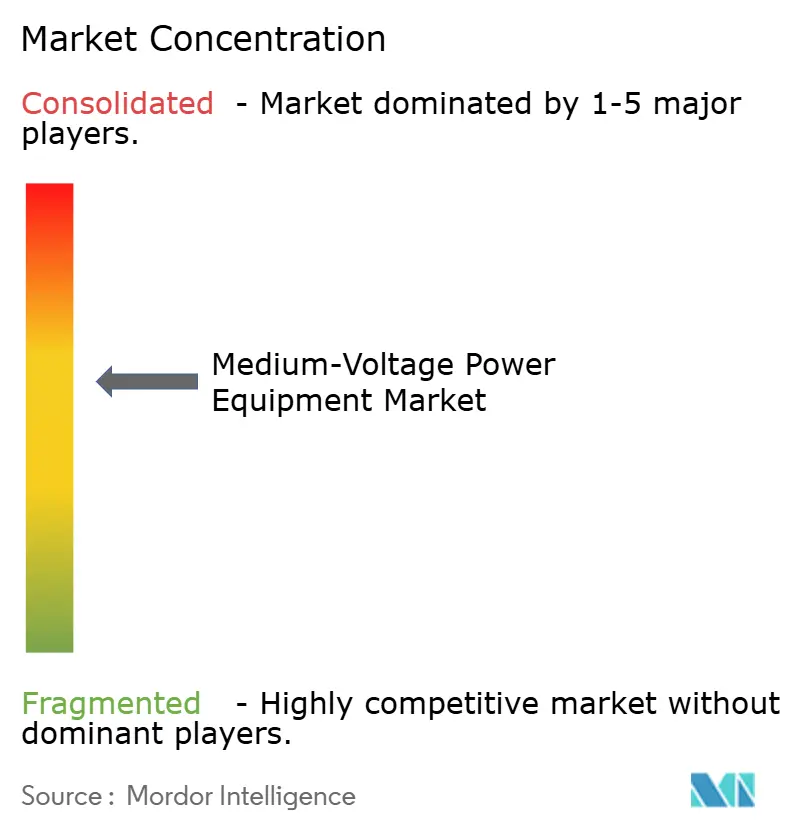
The medium-voltage power equipment market is moderately concentrated among the largest global suppliers and remains fragmented across regional and specialist product categories. ABB, Siemens, Schneider Electric, Eaton, Hitachi Energy, and GE Vernova are prominent suppliers across core equipment categories. Chinese suppliers, including CHINT Group, are expanding their export position in Southeast Asia, the Middle East, and Africa. Hyundai Electric, Hyosung Heavy Industries, and other regional suppliers maintain strong domestic or specialized positions. Product qualification, installed service capacity, and delivery reliability are major competitive factors.
Manufacturing expansion is a central strategy among leading companies in 2026. ABB announced USD 200 million of investment across European medium-voltage operations, including a USD 100 million facility in Dalmine, Italy. GE Vernova is investing USD 1.3 billion across U.S. manufacturing sites through 2028 and has completed its USD 5.3 billion acquisition of Prolec GE to strengthen transformer supply. Eaton announced a new USD 30 million-plus facility in Nebraska focused on high-volume switchgear for AI data centers. These actions strengthen production footprints near large grid and data-center projects.
Medium-Voltage Power Equipment Industry Leaders* ABB Ltd.
- Siemens AG
- Schneider Electric SE
- Eaton Corporation plc
- Hitachi Energy Ltd.
- *Disclaimer: Major Players sorted in no particular order
Image © Vijeron Intelligence. Reuse requires attribution under CC BY 4.0.Medium-Voltage Power Equipment Market Companies Covered in this Report* ABB Ltd.
- Siemens AG
- Schneider Electric SE
- Eaton Corporation plc
- Hitachi Energy Ltd.
- GE Vernova Inc.
- Mitsubishi Electric Corporation
- Toshiba Energy Systems and Solutions Corporation
- Fuji Electric Co., Ltd.
- Bharat Heavy Electricals Limited
- CG Power and Industrial Solutions Limited
- Larsen & Toubro Limited
- WEG S.A.
- Hyundai Electric & Energy Systems Co., Ltd.
- Hyosung Heavy Industries Corporation
- CHINT Group
- Lucy Electric
- Powell Industries, Inc.
- Ormazabal
- NOJA Power Switchgear Pty Ltd
- G&W Electric Company
- S&C Electric Company
Section 7
Recent Industry Developments in Medium-Voltage Power Equipment Market* July 2026: GE Vernova announced an expansion of its Charleroi, Pennsylvania power transmission manufacturing facility as part of a USD 138 million investment, expected to create approximately 275 new high-skilled manufacturing jobs through 2028. The facility produces switchgear and is central to GE Vernova's strategy to address rising demand for grid infrastructure across North America.
- May 2026: Siemens and Jabil announced plans to operate a 300,000-square-foot manufacturing facility in Prince George's County, Virginia, targeting U.S. production of medium-voltage switchgear and integrated power delivery solutions, with production slated to begin in fall 2026 and at least 350 jobs to be created. This investment addresses surging data-center and utility equipment demand in North America.
- May 2026: ABB invested approximately USD 200 million across European MV manufacturing, including a new USD 100 million facility in Dalmine, Italy, and capacity expansion at factories in Bulgaria, Finland, Germany, Norway, and Poland, scaling production of SF6-free switchgear, GIS, vacuum interrupters, and relays.
- May 2026: Hitachi Energy announced a BRL 50 million investment, USD 11 million, to establish a new service operations center in Greater São Paulo, Brazil, dedicated to transformer and grid equipment servicing, with operations expected by the end of 2026.
Section 8
Table of Contents for Medium-Voltage Power Equipment Industry Report1. INTRODUCTION
- 1.1 Study Assumptions and Market Definition
- 1.2 Scope of the Study
- RESEARCH METHODOLOGY
- EXECUTIVE SUMMARY
- MARKET LANDSCAPE
- 4.1 Market Overview
- 4.2 Market Drivers* 4.2.1 Aging Grid Replacement and Reliability Upgrades
- 4.2.2 Renewable-Energy and Distributed-Generation Integration
- 4.2.3 Industrial Electrification and Data-Center Load Growth
- 4.2.4 Smart-Grid, Automation, and Digital-Substation Deployment
- 4.2.5 Utility-Scale Battery Storage and Bidirectional Power Flows
- 4.2.6 Inter-Data-Center Power Looping and High-Availability Distribution
- 4.3 Market Restraints* 4.3.1 High Upfront Cost and Lengthy Utility Qualification
- 4.3.2 Copper, Steel, Semiconductor, and Component Supply Volatility
- 4.3.3 SF6-Free Technology Validation and Compliance Costs
- 4.3.4 Wildfire-Insurance and PCB-Legacy Liability for Oil-Filled Transformers
- 4.4 Supply-Chain Analysis
- 4.5 Porter's Five Forces Analysis* 4.5.1 Bargaining Power of Suppliers
- 4.5.2 Bargaining Power of Buyers
- 4.5.3 Threat of New Entrants
- 4.5.4 Threat of Substitutes
- 4.5.5 Competitive Rivalry
- 4.6 Technology Outlook
- 4.7 Regulatory Landscape
- 4.8 Investment Analysis
- MARKET SIZE AND GROWTH FORECASTS
- 5.1 By Equipment Type* 5.1.1 Turbines (Steam, Gas and Wind)
- 5.1.2 Generators (Diesel, Gas, Hybrid)
- 5.1.3 Transformers
- 5.1.4 Switchgear
- 5.1.5 Circuit Breakers
- 5.1.6 Power Cables
- 5.1.7 Other Equipment
- 5.2 By Power Generation Source* 5.2.1 Thermal
- 5.2.2 Nuclear
- 5.2.3 Renewables
- 5.3 By Application* 5.3.1 Power Generation
- 5.3.2 Transmission
- 5.3.3 Distribution
- 5.4 By End-User* 5.4.1 Residential
- 5.4.2 Commercial
- 5.4.3 Industrial
- 5.4.4 Utility
- 5.5 By Geography* 5.5.1 North America
- 5.5.1.1 United States
- 5.5.1.2 Canada
- 5.5.1.3 Mexico
- 5.5.2 Europe
- 5.5.2.1 Germany
- 5.5.2.2 France
- 5.5.2.3 Italy
- 5.5.2.4 Spain
- 5.5.2.5 United Kingdom
- 5.5.2.6 Poland
- 5.5.2.7 Russia
- 5.5.2.8 Rest of Europe
- 5.5.3 Asia-Pacific
- 5.5.3.1 China
- 5.5.3.2 India
- 5.5.3.3 Japan
- 5.5.3.4 South Korea
- 5.5.3.5 Australia
- 5.5.3.6 Indonesia
- 5.5.3.7 Vietnam
- 5.5.3.8 Thailand
- 5.5.3.9 Rest of Asia-Pacific
- 5.5.4 South America
- 5.5.4.1 Brazil
- 5.5.4.2 Argentina
- 5.5.4.3 Chile
- 5.5.4.4 Rest of South America
- 5.5.5 Middle East and Africa
- 5.5.5.1 Saudi Arabia
- 5.5.5.2 United Arab Emirates
- 5.5.5.3 Egypt
- 5.5.5.4 South Africa
- 5.5.5.5 Morocco
- 5.5.5.6 Rest of Middle East and Africa
- COMPETITIVE LANDSCAPE
- 6.1 Market Concentration
- 6.2 Strategic Moves
- 6.3 Market Share Analysis
- 6.4 Company Profiles (includes Global Level Overview, Market Level Overview, Core Segments, Financials as available, Strategic Information, Market Rank/Share, Products and Services, Recent Developments)* 6.4.1 ABB Ltd.
- 6.4.2 Siemens AG
- 6.4.3 Schneider Electric SE
- 6.4.4 Eaton Corporation plc
- 6.4.5 Hitachi Energy Ltd.
- 6.4.6 GE Vernova Inc.
- 6.4.7 Mitsubishi Electric Corporation
- 6.4.8 Toshiba Energy Systems and Solutions Corporation
- 6.4.9 Fuji Electric Co., Ltd.
- 6.4.10 Bharat Heavy Electricals Limited
- 6.4.11 CG Power and Industrial Solutions Limited
- 6.4.12 Larsen & Toubro Limited
- 6.4.13 WEG S.A.
- 6.4.14 Hyundai Electric & Energy Systems Co., Ltd.
- 6.4.15 Hyosung Heavy Industries Corporation
- 6.4.16 CHINT Group
- 6.4.17 Lucy Electric
- 6.4.18 Powell Industries, Inc.
- 6.4.19 Ormazabal
- 6.4.20 NOJA Power Switchgear Pty Ltd
- 6.4.21 G&W Electric Company
- 6.4.22 S&C Electric Company
- MARKET OPPORTUNITIES AND FUTURE OUTLOOK
- 7.1 White-Space and Unmet-Need Assessment
Section 9
Global Medium-Voltage Power Equipment Market Report ScopeMedium-Voltage (MV) Power Equipment refers to electrical equipment designed to generate, transform, distribute, switch, protect, control, and manage electrical power at medium-voltage levels, typically ranging from 1 kV to 36 kV AC, depending on the applicable industry standard or regional classification. This equipment is primarily used in electric utilities, industrial facilities, commercial buildings, renewable energy projects, data centers, transportation infrastructure, and distribution networks to safely transmit and distribute electricity between high-voltage transmission systems and low-voltage end users.
The Medium-Voltage Power Equipment Market is segmented by equipment type, power generation source, application, end-user, and geography. By equipment type, the market is segmented into turbines, generators, transformers, switchgear, circuit breakers, cables, and other equipment. By power generation source, the market is segmented into thermal, nuclear, and renewables. By application, the market is segmented into power generation, transmission, and distribution. By end-user, the market is segmented into residential, commercial, industrial, and utility. The report also covers the market size and forecasts for the global Medium-Voltage Power Equipment Market across 26 countries in key regions. For each segment, the market sizing and forecasts have been provided on the basis of value (USD).
By Equipment TypeTurbines (Steam, Gas and Wind) |
Generators (Diesel, Gas, Hybrid) |
Transformers |
Switchgear |
Circuit Breakers |
Power Cables |
Other Equipment |
By Power Generation SourceThermal |
Nuclear |
Renewables |
By ApplicationPower Generation |
Transmission |
Distribution |
By End-UserResidential |
Commercial |
Industrial |
Utility |
By GeographyNorth America | United States |
| Canada |
|---|
| Mexico |
Europe | Germany |
| France |
|---|
| Italy |
| Spain |
| United Kingdom |
| Poland |
| Russia |
| Rest of Europe |
Asia-Pacific | China |
| India |
|---|
| Japan |
| South Korea |
| Australia |
| Indonesia |
| Vietnam |
| Thailand |
| Rest of Asia-Pacific |
South America | Brazil |
| Argentina |
|---|
| Chile |
| Rest of South America |
Middle East and Africa | Saudi Arabia |
| United Arab Emirates |
|---|
| Egypt |
| South Africa |
| Morocco |
| Rest of Middle East and Africa |
By Equipment Type | Turbines (Steam, Gas and Wind) |
| Generators (Diesel, Gas, Hybrid) |
|---|
| Transformers |
| Switchgear |
| Circuit Breakers |
| Power Cables |
| Other Equipment |
By Power Generation Source | Thermal |
| Nuclear |
|---|
| Renewables |
By Application | Power Generation |
| Transmission |
|---|
| Distribution |
By End-User | Residential |
| Commercial |
|---|
| Industrial |
| Utility |
By Geography | North America | United States |
| Canada | |
|---|---|
| Mexico | |
| Europe | Germany |
| France | |
| Italy | |
| Spain | |
| United Kingdom | |
| Poland | |
| Russia | |
| Rest of Europe | |
| Asia-Pacific | China |
| India | |
| Japan | |
| South Korea | |
| Australia | |
| Indonesia | |
| Vietnam | |
| Thailand | |
| Rest of Asia-Pacific | |
| South America | Brazil |
| Argentina | |
| Chile | |
| Rest of South America | |
| Middle East and Africa | Saudi Arabia |
| United Arab Emirates | |
| Egypt | |
| South Africa | |
| Morocco | |
| Rest of Middle East and Africa |
Section 10
Key Questions Answered in the ReportWhat is the projected value of medium-voltage power equipment in 2031? The sector is projected to reach USD 644.19 billion by 2031, growing at a 6.31% CAGR from 2026.
Which equipment category held the largest revenue share in 2025? Other Equipment held 54.8% of revenue in 2025, led by products such as ring main units, protection relays, automation controllers, and smart meters.
Which end-user category is growing fastest through 2031? Residential applications are forecast to grow at a 7.5% CAGR, supported by neighborhood-level solar, storage, charging, and microgrid infrastructure.
Why are data centers increasing demand for medium-voltage equipment? Large campuses need dedicated switchgear, transformers, and backup generation before they can operate.
How is SF6 regulation changing equipment purchasing? Suppliers are developing vacuum and clean-air alternatives because compliance requirements and lifecycle obligations are becoming important tender criteria.