Optical Character Recognition Market Size & Share Analysis - Growth Trends and Forecast (2026 - 2031)
Optical Character Recognition Market Size & Share Analysis - Growth Trends and Forecast (2026 - 2031)
Industry: Technology, Media & Telecom (TMT)
Source: https://www.mordorintelligence.com/industry-reports/optical-character-recognition-market
Scraped Date: 2026-09-17
Key Market Estimates
| Variable | Value | Unit |
|---|
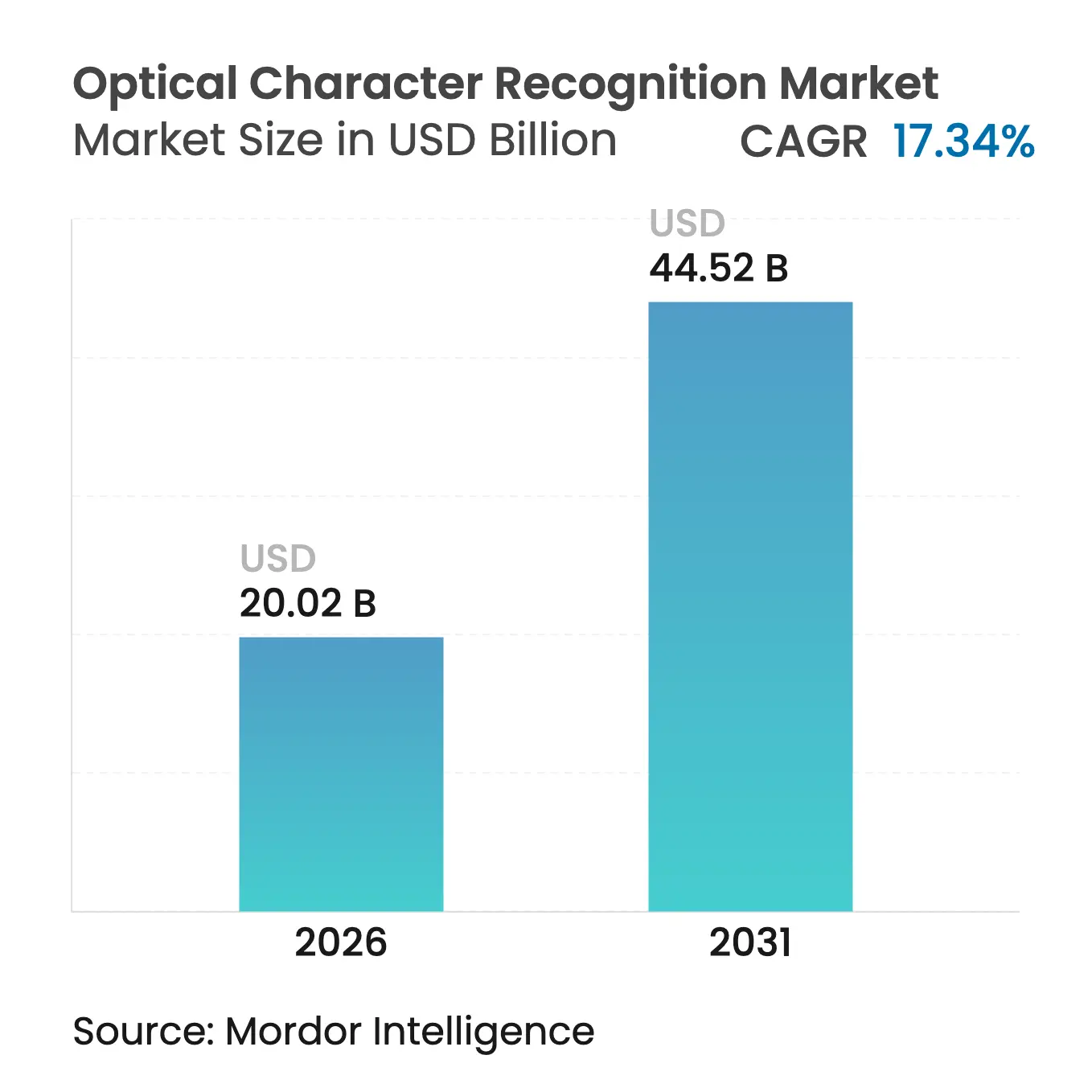
| Market Size (2026) | 20.02 | USD Billion |
|---|
| Market Size (2031) | 44.52 | USD Billion |
|---|
| Growth Rate (2026 - 2031) | 17.34 | PERCENT |
|---|
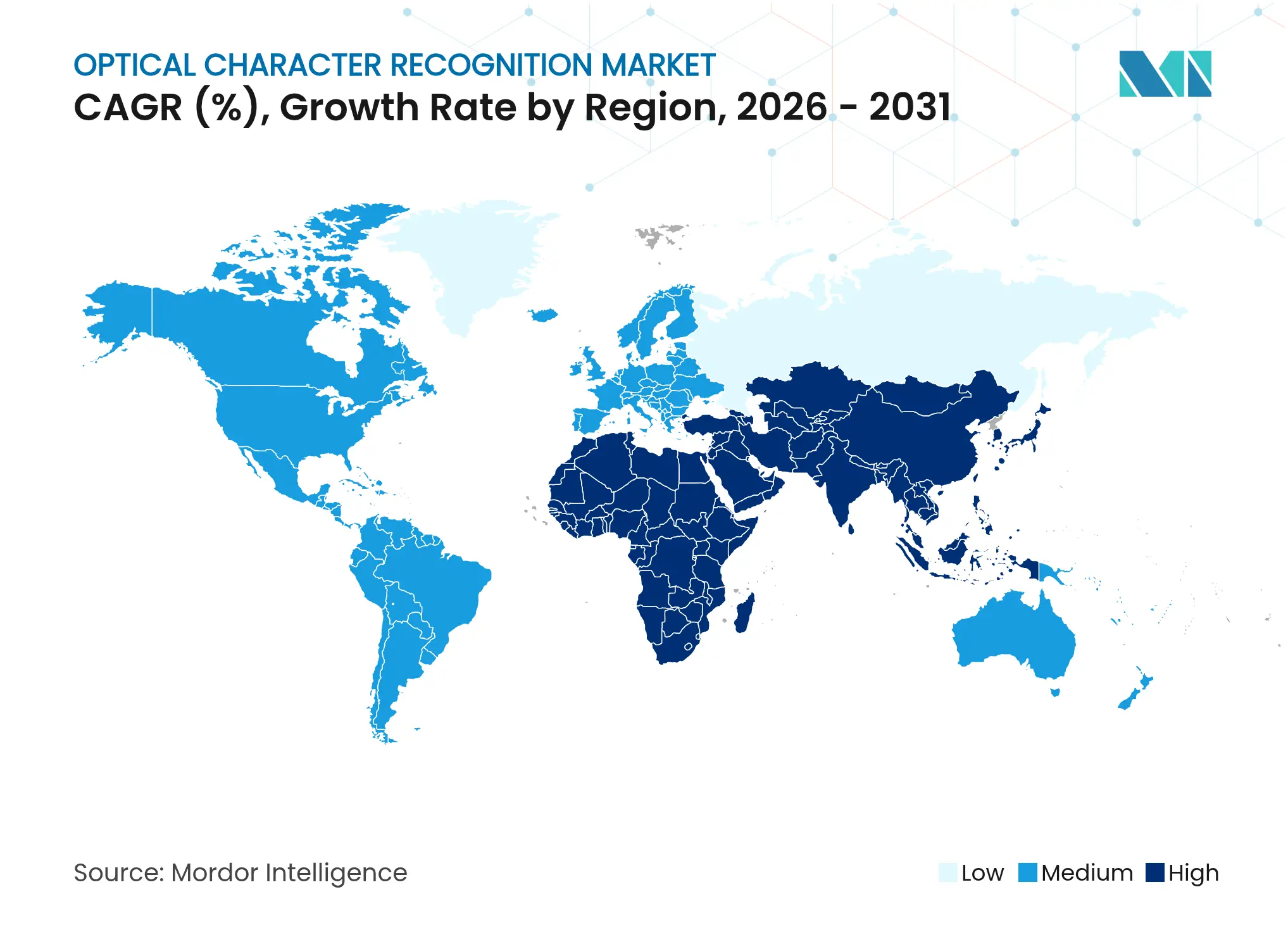
| Fastest Growing Market | Asia Pacific |
|---|
| Largest Market | North America |
|---|
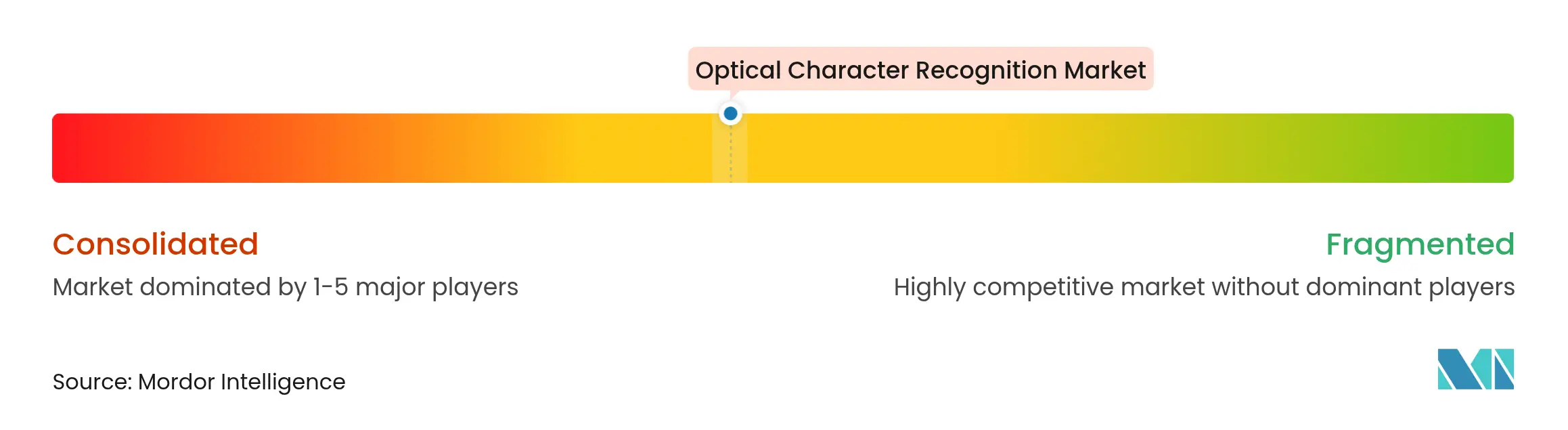
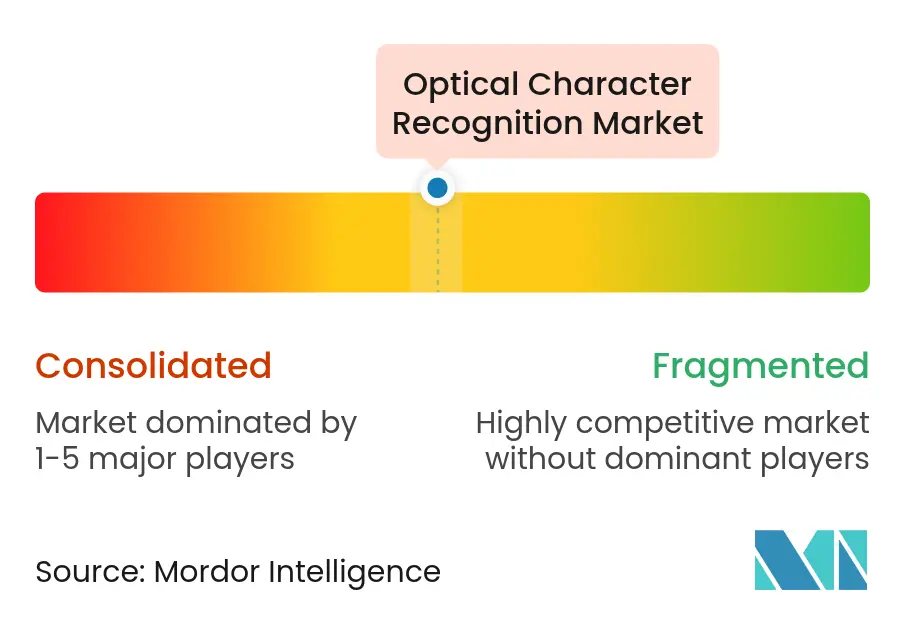
| Market Concentration | Medium |
|---|

!Chart,-Growth-Rate-by-Region,-2025---2030-1750422620376-reseller.png)







Section 1
Optical Character Recognition Market Size & Share Analysis - Growth Trends and Forecast (2026 - 2031)The Optical Character Recognition Market is Segmented by Type (Software [Mobile OCR Software, and More], Services [Professional Services, and More]), Deployment Mode (On-Premise, and Cloud), Technology (Conventional OCR, and More), Application (Invoice and Bill Processing, and More), End-User Industry (BFSI, Retail and E-Commerce, and More), and Geography. The Market Forecasts are Provided in Terms of Value (USD).
Section 2
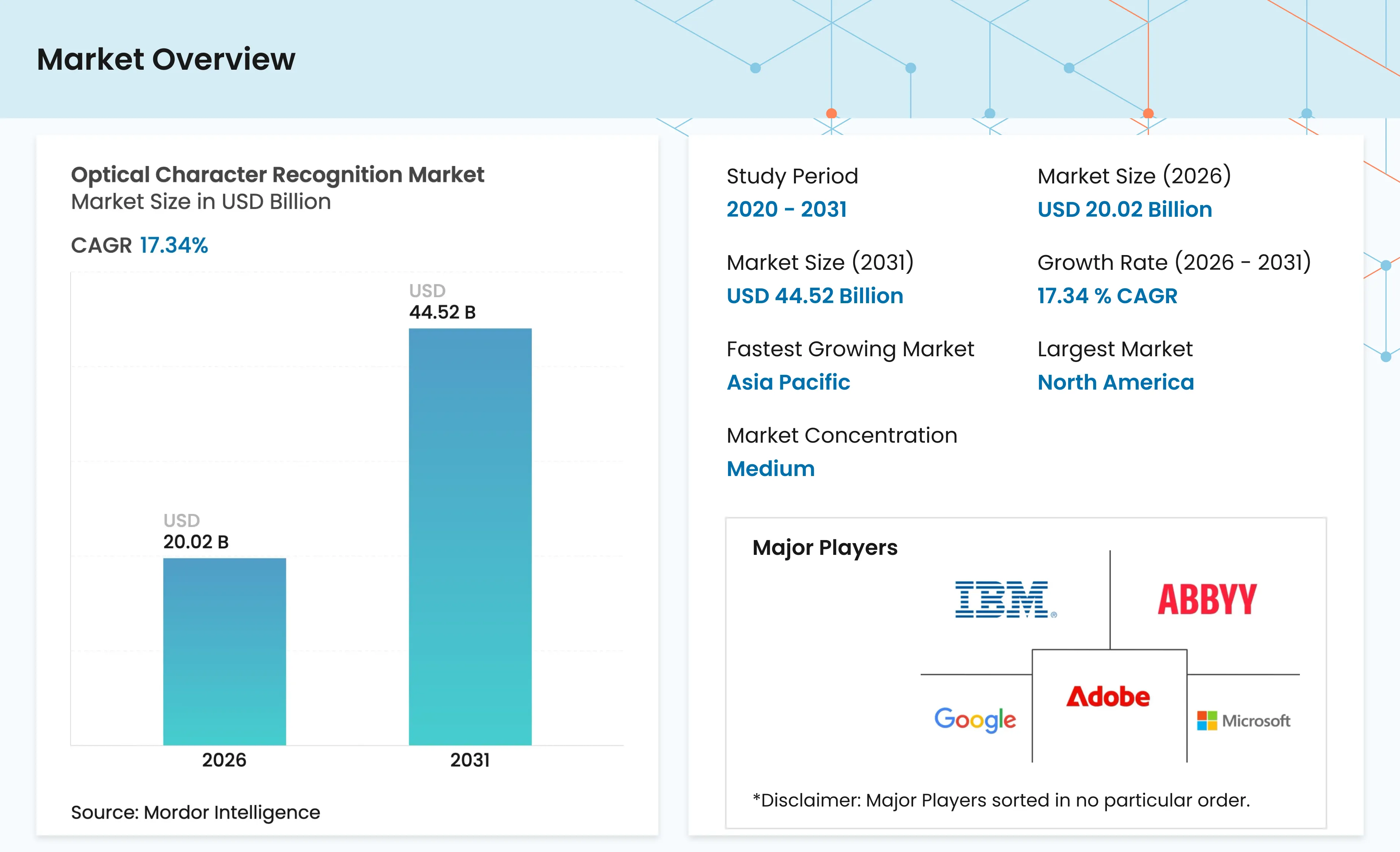
Optical Character Recognition Market Size and ShareMarket Overview
Study Period | 2020 - 2031 |
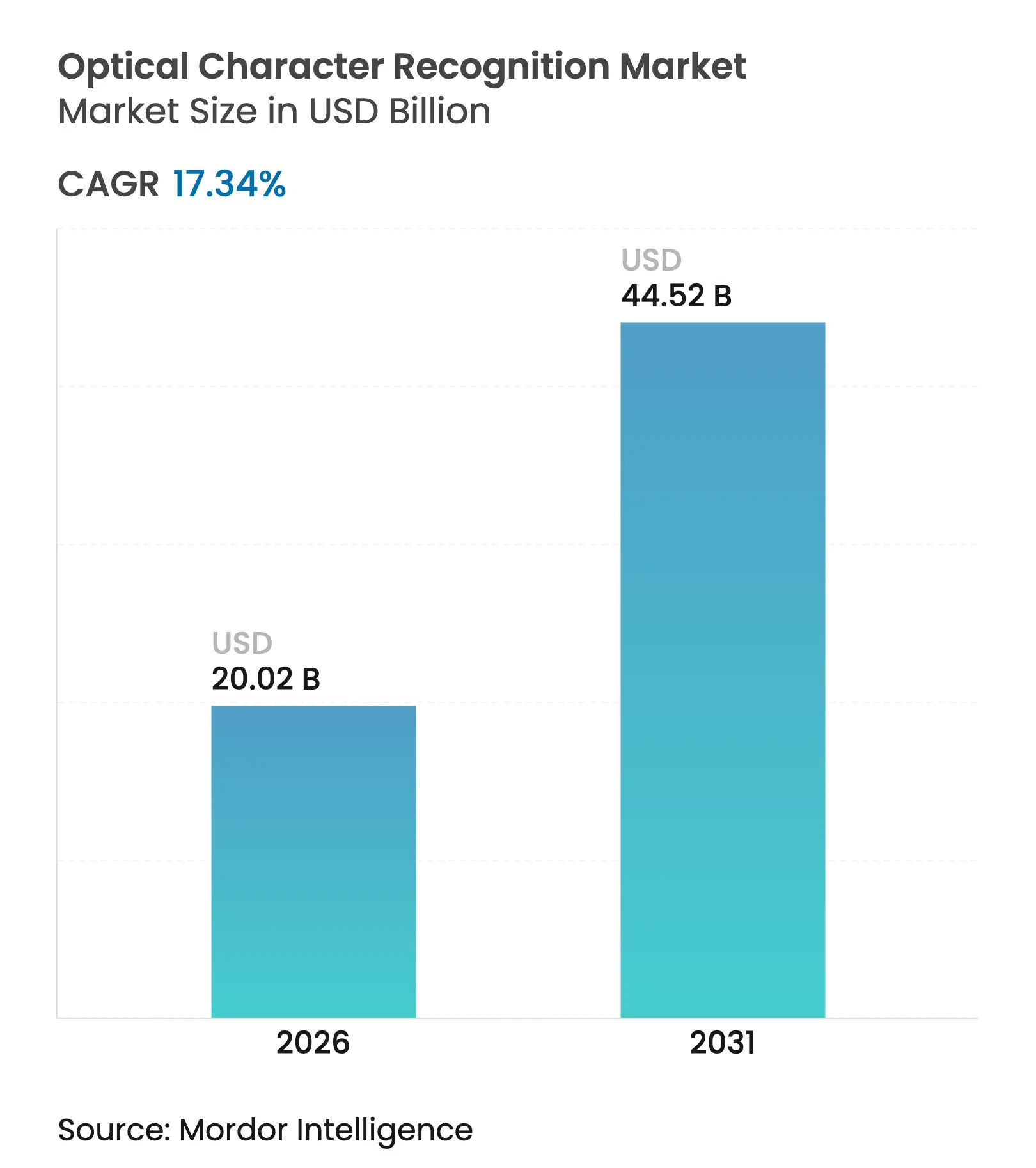
Market Size (2026) | USD 20.02 Billion |
Market Size (2031) | USD 44.52 Billion |
Growth Rate (2026 - 2031) | 17.34 % CAGR |
Fastest Growing Market | Asia Pacific |
Largest Market | North America |
Market Concentration | Medium |
Major Players*Disclaimer: Major Players sorted in no particular order.
Image © Vijeron Intelligence. Reuse requires attribution under CC BY 4.0.
Image © Vijeron Intelligence. Reuse requires attribution under CC BY 4.0.
Section 3
Optical Character Recognition Market Analysis by Vijeron IntelligenceThe optical character recognition market size is expected to grow from USD 17.06 billion in 2025 to USD 20.02 billion in 2026 and is forecast to reach USD 44.52 billion by 2031 at 17.34% CAGR over 2026-2031. Growth is propelled by AI-driven accuracy gains, expanding cloud deployment, and tighter regulatory mandates that encourage automated compliance checks. Technology vendors are shifting from standalone OCR engines to full-stack document-intelligence platforms that combine recognition, classification, and validation in a single workflow. Multimodal large language models, which read both images and text, are lowering per-page processing costs and widening adoption across small and midsize enterprises. Intensifying competition is pushing suppliers to differentiate through domain-specific templates, language support, and value-added analytics rather than pure extraction speed.
Key Report Takeaways
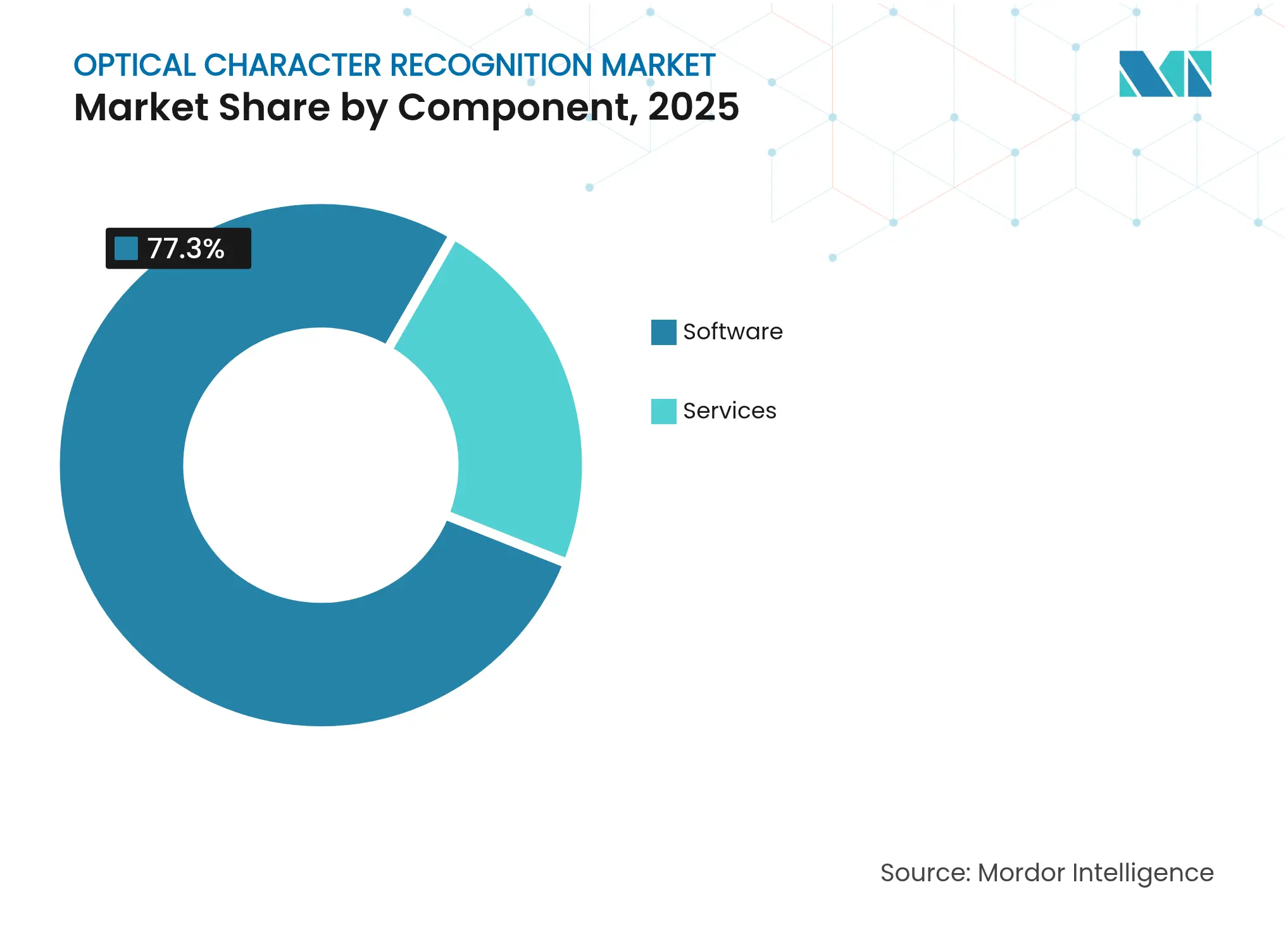
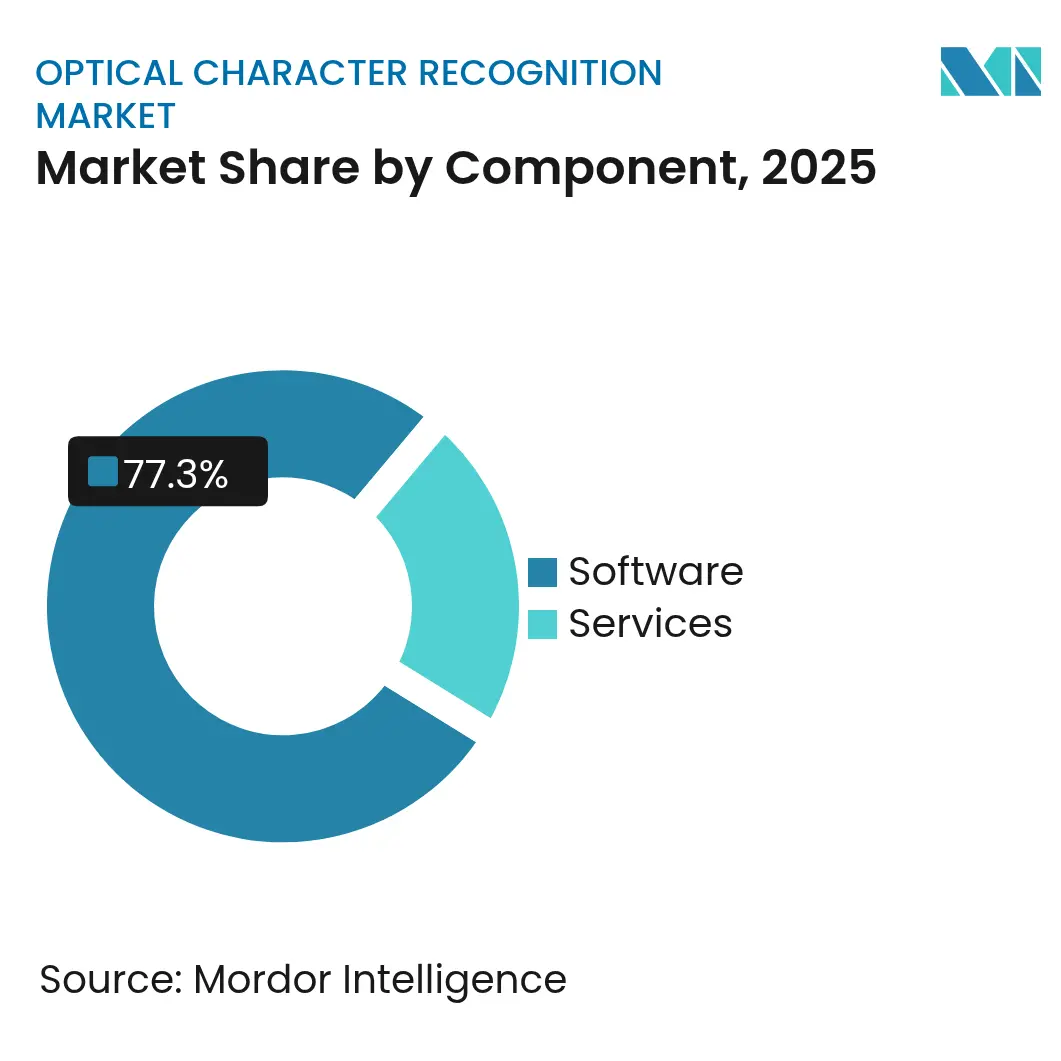
- By component, Software led with 77.30% revenue share in 2025, while Services is projected to expand at a 17.36% CAGR through 2031.
- By deployment Mode, Cloud accounted for 65.20% of the optical character recognition market share in 2025; On-Premise solutions are growing fastest at 15.45% CAGR to 2031.
- By technology, Conventional OCR retained 70.40% share in 2025; Intelligent Character Recognition is advancing at a 18.95% CAGR over the outlook period.
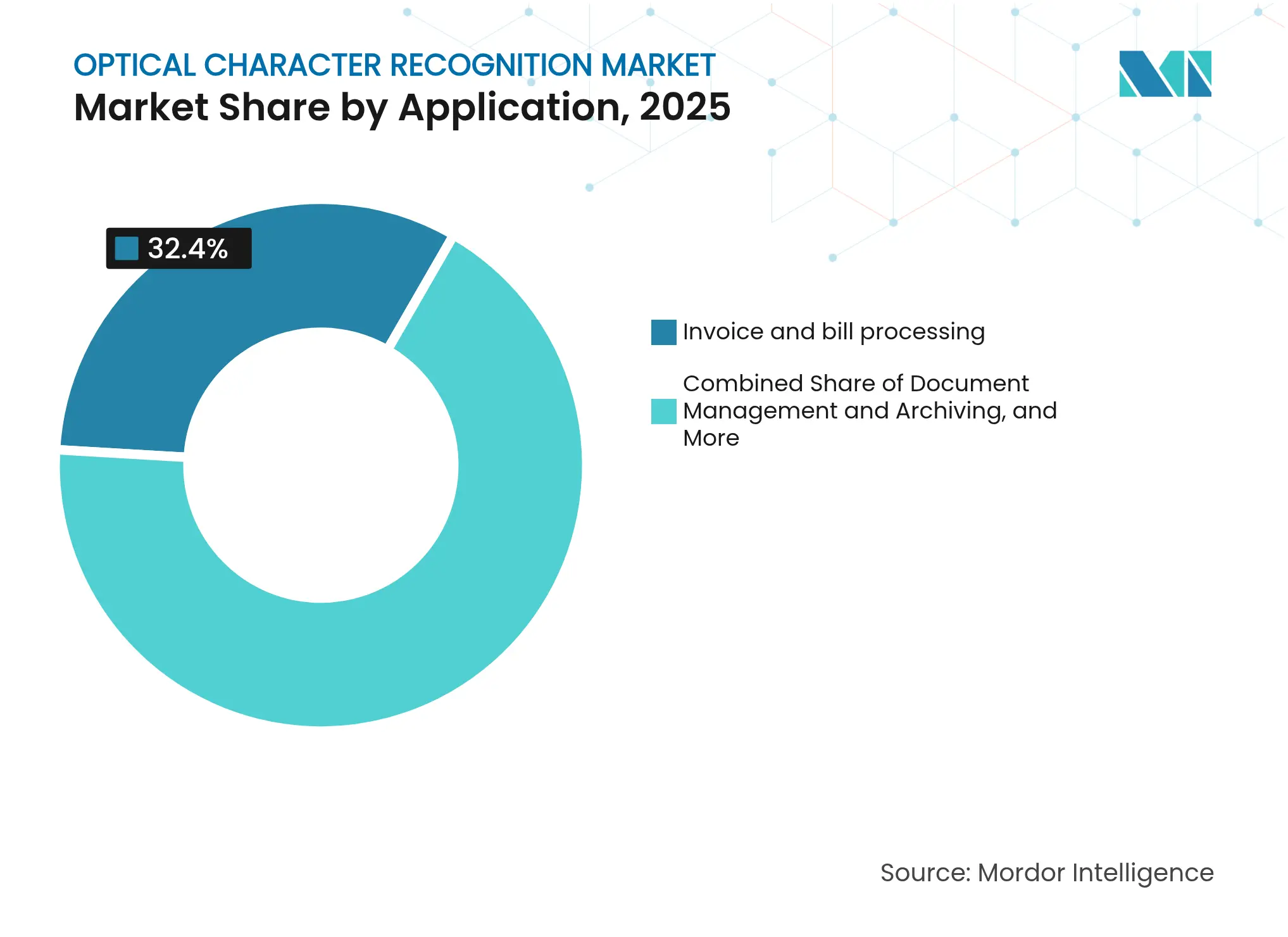
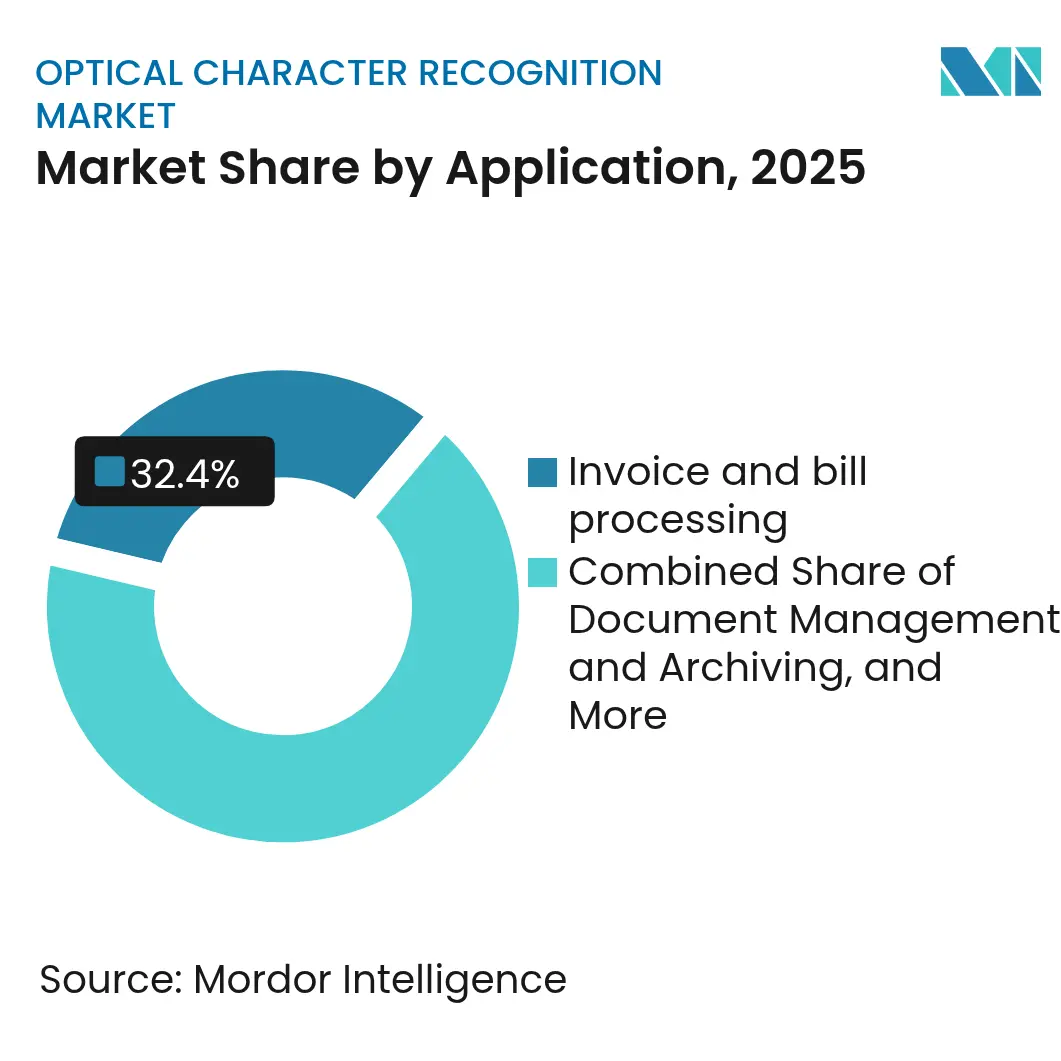
- By application, Invoice and Bill Processing held 32.40% of the optical character recognition market size in 2025, whereas Identity Verification and KYC is forecast to grow at 17.85% CAGR.
- By end-use industry, BFSI commanded 25.60% share of the optical character recognition market size in 2025, but Healthcare is set to post the highest CAGR at 19.45%.
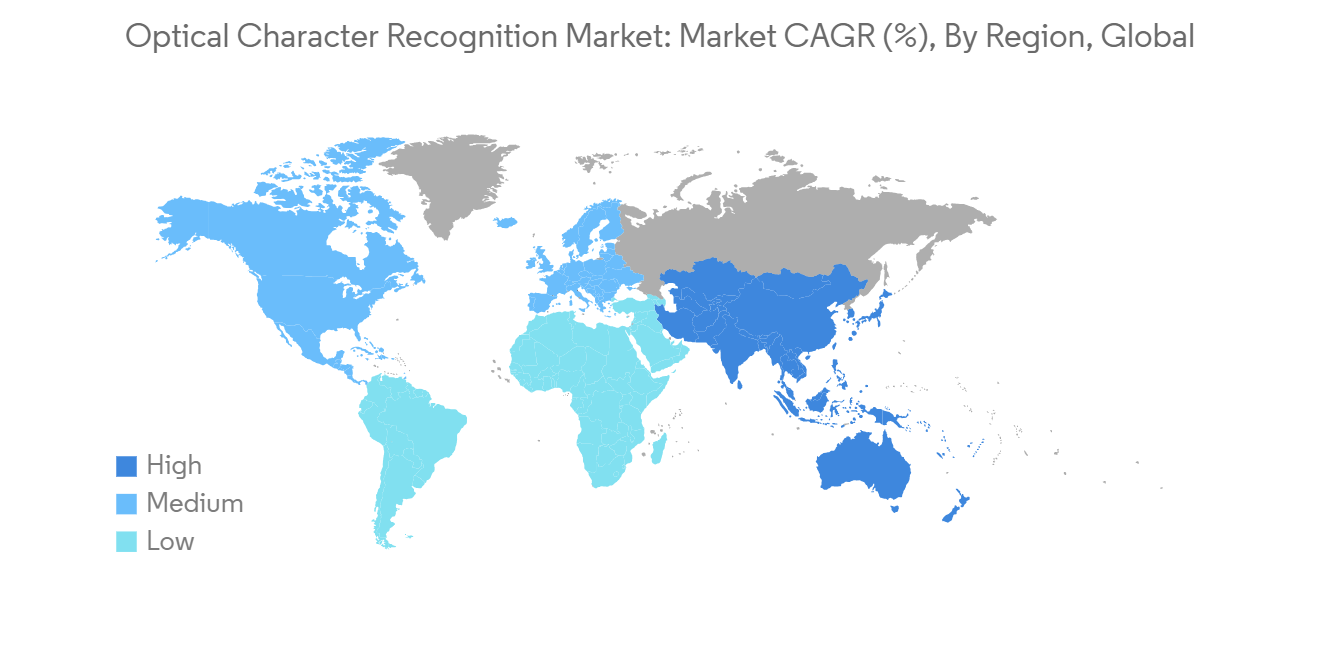
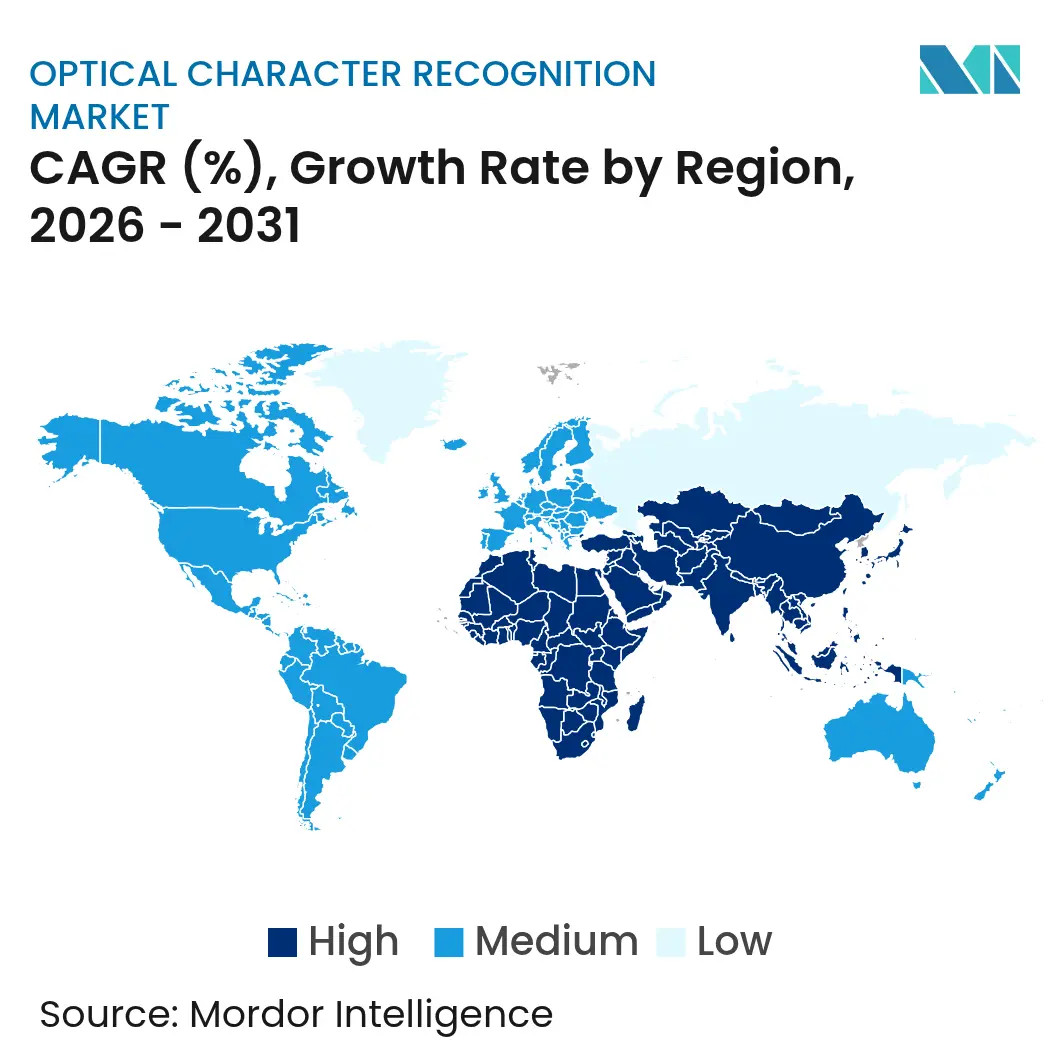
- By geography, North America led with 39.50% revenue share in 2025, yet Asia-Pacific is projected to rise at 17.58% CAGR to 2031.
Note: Market size and forecast figures in this report are generated using Vijeron Intelligence's proprietary estimation framework, updated with the latest available data and insights as of 2026.
Section 4
Global Optical Character Recognition Market Trends and InsightsDrivers Impact Analysis
Driver
(~) % Impact on CAGR Forecast
Geographic Relevance
Impact Timeline
Rising automation in industries
+3.5%
North America, Europe
Medium term (2-4 years)
Adoption of cloud technology
+2.8%
North America (early), global
Short term (≤ 2 years)
Integration with IDP platforms
+2.1%
North America, Europe, advanced Asia-Pacific
Medium term (2-4 years)
AI-powered OCR for healthcare claims
+1.9%
North America, Europe, advanced Asia-Pacific
Medium term (2-4 years)
Accessibility-compliance regulations
+1.4%
North America, Europe, emerging Asia-Pacific
Long term (≥ 4 years)
Low-code OCR SDK uptake by SMBs
+1.2%
Emerging markets worldwide
Short term (≤ 2 years)
Source: Vijeron Intelligence |
Rising automation in industries
Manufacturing and logistics organizations are embedding AI-driven OCR in supply-chain workflows to capture data from shipping labels, invoices, and pick-lists in real time. Accuracy levels of 97% under challenging lighting conditions increase throughput and cut manual touchpoints by 50% [1]. Automatic number-plate recognition aligns with warehouse gates to speed vehicle entry, demonstrating how the optical character recognition market extends beyond documents to physical assets.
Zebra Technologies, “A Deeper Dive on Deep Learning OCR,” zebra.comAdoption of cloud technology
Consumption-based cloud OCR removes up-front capital requirements and delivers instant algorithm updates. Azure Form Recognizer exemplifies this shift, providing pay-as-you-go pricing that attracts firms with variable document volumes. Browser-based engines using WebAssembly process IDs locally to satisfy privacy rules, allowing SMEs in stringent jurisdictions to benefit from cloud scalability without sending data off-site.
Integration with IDP platforms
Vendors bundle OCR, classification, and validation into end-to-end intelligent document processing suites. ABBYY FlexiCapture offers pre-built templates for mortgage applications and healthcare claims, reducing processing times by 80% and error rates by 95% [2]. This platform orientation positions the optical character recognition market as a linchpin of broader automation strategies.
ABBYY, “Recent News & Activity,” abbyy.comAI-powered OCR for healthcare claims
Healthcare payers automate extraction from explanation-of-benefit forms to structured ERA files, accelerating reimbursement and lowering administrative overhead. HIPAA-compliant security frameworks ensure protected health information remains encrypted throughout the workflow, addressing a critical adoption barrier.
Restraints Impact Analysis
Restraint
(~) % Impact on CAGR Forecast
Geographic Relevance
Impact Timeline
High initial investment costs
-1.2%
Emerging markets, SMBs
Short term (≤ 2 years)
Data-privacy concerns in cloud OCR
-0.8%
Europe, regulated sectors worldwide
Medium term (2-4 years)
Low-resource language handwriting limits
-0.7%
Asia-Pacific, MEA, LATAM
Long term (≥ 4 years)
GPU supply constraints for deep-learning OCR
-0.5%
Global
Short term (≤ 2 years)
Source: Vijeron Intelligence |
High initial investment costs
Enterprise-grade OCR deployments entail software licenses, systems integration, and process re-engineering that many SMEs struggle to afford. While subscription pricing mitigates capex, customizing workflows and linking legacy systems keep total cost of ownership high, slowing penetration in price-sensitive segments.
Data-privacy concerns in cloud OCR
European Data Protection Board guidance underscores risks linked to processing sensitive personal data with OCR, compelling many financial and healthcare entities to retain on-premise engines despite higher maintenance overhead. Vendors respond by offering containerized deployments and in-browser processing to balance efficiency and compliance.
*Our forecasts treat driver/restraint impacts as directional, not additive. The impact forecasts reflect baseline growth, mix effects, and variable interactions.
Section 5
Segment AnalysisBy Component: Services Growth Outpaces Software Dominance
The software segment held a 77.30% revenue stake in 2025, establishing a solid base for the optical character recognition market. Services, however, are projected to deliver a 17.36% CAGR through 2031 as organizations demand consulting, customization, and managed operations to realize full ROI. This pivot shows that expertise, not merely code, now unlocks the value of OCR deployments.
Professional-services providers build vertical playbooks that embed industry terminology and regulatory templates into OCR pipelines. Healthcare integrators, for instance, supply medical lexicons to raise extraction precision, whereas banking specialists focus on AML and KYC documents. Managed services relieve internal IT teams from tuning recognition models, ensuring the systems stay current with new document formats.
Note: Segment shares of all individual segments available upon report purchase
Image © Vijeron Intelligence. Reuse requires attribution under CC BY 4.0.By Deployment Mode: Cloud Leads While On-Premise Gains Strategic Importance
Cloud deployments generated 65.20% of 2025 revenue, reflecting customer preference for elastic scaling and automatic algorithm improvements. Even so, on-premise solutions are set to rise at 15.45% CAGR as regulated sectors require data residency. Financial institutions often keep cheque imaging on local servers while shifting less sensitive workflows to the cloud.
Hybrid architectures dominate. Microsoft ships its OCR containers to customer data centers, letting firms process documents locally and still connect to Azure AI for advanced post-processing. This configuration positions the optical character recognition market as both a SaaS and an appliance play, depending on compliance thresholds.
By Technology: Intelligent Character Recognition Disrupts Traditional OCR
Conventional OCR retained 70.40% of 2025 revenue, yet Intelligent Character Recognition is forecast to advance 18.95% CAGR because it deciphers cursive scripts and semi-structured forms. Deep-learning ICR engines now hit 85% accuracy on clear handwriting, expanding the addressable workload beyond typed invoices.
Optical mark and intelligent word recognition modules complement ICR, processing check-boxes and short free-text notes. Multimodal AI models, capable of reading entire document layouts, further erode the distinction between OCR and natural language processing, creating a convergence zone that redefines the optical character recognition market.
Recognized by Experts. Trusted by Leaders.
A trusted intelligence partner to global decision-makers across 90+ countries.
By Application: Identity Verification Emerges as Growth Leader
Invoice and bill processing kept 32.40% share in 2025, anchoring core demand, while Identity Verification and KYC is projected to scale at 17.85% CAGR. Banks and fintechs integrate OCR with facial recognition to authenticate documents during mobile onboarding, cutting customer acquisition times from days to minutes.
Document management, although mature, remains essential as firms digitize archives for searchability. Packaging and label recognition leverages OCR for traceability across manufacturing lines, while healthcare providers combine OCR with clinical NLP to code unstructured notes. These specialized cases expand the optical character recognition market beyond accounts-payable hubs.
Note: Segment shares of all individual segments available upon report purchase
Image © Vijeron Intelligence. Reuse requires attribution under CC BY 4.0.By End-Use Industry: Healthcare Digitization Drives Fastest Growth
BFSI controlled 25.60% revenue in 2025 through loan files, statements, and compliance records. Healthcare is poised for a 19.45% CAGR, fueled by electronic health-record mandates and the need to automate claims. OCR engines trained on clinical vocabularies extract diagnosis codes directly from scanned charts, improving billing accuracy.
Retail and e-commerce businesses employ OCR for product-label capture and customer ID checks at pickup points. Government agencies digitize land records and passports to modernize citizen services. Manufacturing plants embed OCR in quality-control stations, ensuring regulatory labels match batch data.
Section 6
Geography AnalysisNorth America commanded 39.50% of optical character recognition market revenue in 2025, underpinned by high labor costs that justify automation and by a dense cluster of technology suppliers. HIPAA and KYC regulations accelerate adoption in healthcare and banking. Vendors in the region integrate OCR with robotic-process-automation bots, generating compound efficiency gains.
Asia-Pacific is the fastest-growing territory at 17.58% CAGR. China’s cloud providers, such as Alibaba Cloud and Tencent Cloud, bundle recognition services with broader AI suites, lowering entry barriers for local firms. India’s digitization programs and high-volume banking sector create fertile ground for KYC OCR, while Japan and South Korea focus on manufacturing quality control.
Europe shows strong uptake across public and private sectors but remains cautious on data sovereignty. Germany and France favor on-premise or sovereign-cloud installations to meet GDPR. Supply-chain resiliency goals push logistics firms toward automated document capture for end-to-end visibility, sustaining steady growth in the region.
Image © Vijeron Intelligence. Reuse requires attribution under CC BY 4.0.
Section 7
Competitive LandscapeMarket Concentration
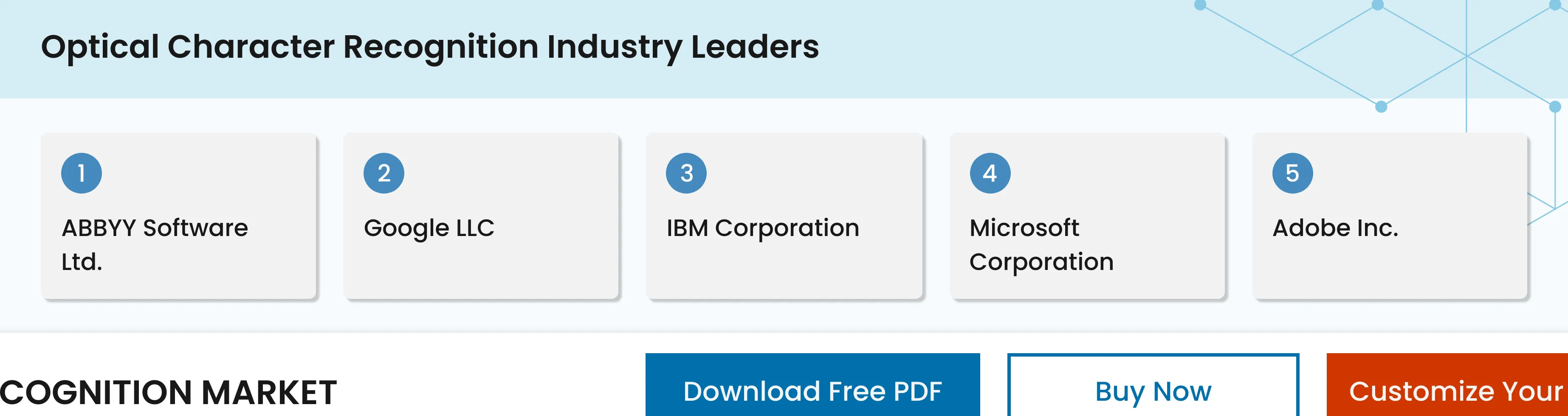
Image © Vijeron Intelligence. Reuse requires attribution under CC BY 4.0.The optical character recognition market features a mix of diversified software giants and niche AI entrants. Adobe, Google, and Microsoft embed OCR into broader productivity suites, offering wide reach. ABBYY, Kofax, and UiPath differentiate through vertical templates and workflow orchestration. Startups such as Mistral AI use large language models to reach 99% accuracy at USD 1 per 1,000 pages, raising the competitive bar [3].
Strategic moves include API launches for developer ecosystems, acquisitions that add regulatory expertise, and containerized deployments for edge processing. Descartes Systems Group’s purchase of OCR Services expands trade-compliance coverage, while ABBYY’s new API targets low-code integration. White-space remains in low-resource language support and blockchain-verified document authenticity.
As vendors converge on similar deep-learning techniques, differentiation shifts to pre-built domain knowledge, governance features, and total cost of ownership. Partnerships with hyperscale clouds and RPA platforms extend market reach, keeping competition active yet preventing monopolistic dominance.
Campus Technology, “Mistral AI Introduces AI-Powered OCR,” campustechnology.com
Section 8
Optical Character Recognition Industry Leaders1 ABBYY Software Ltd.2 Google LLC3 IBM Corporation4 Microsoft Corporation5 Adobe Inc.*Disclaimer: Major Players sorted in no particular order
Section 9
Recent Industry Developments* April 2025: ABBYY launched an OCR API that boosts accuracy in intelligent-automation workflows, reinforcing its Everest Group leadership position.
- April 2025: OCR Studio released a WebAssembly-based engine for browser-based ID verification covering 220 jurisdictions.
- March 2025: Mistral AI introduced an OCR API processing 2,000 pages per minute at 97-99.54% accuracy across 11 languages
- March 2024: Descartes Systems Group acquired OCR Services for USD 90 million, expanding its global trade-compliance suite.
Section 10
Table of Contents for Optical Character Recognition Industry Report1. INTRODUCTION
- 1.1 Market Definition and Study Assumptions
- 1.2 Scope of the Study
- RESEARCH METHODOLOGY
- EXECUTIVE SUMMARY
- MARKET LANDSCAPE
- 4.1 Market Overview
- 4.2 Market Drivers* 4.2.1 Rising automation in industries
- 4.2.2 Adoption of cloud technology
- 4.2.3 Integration with IDP platforms
- 4.2.4 AI-powered OCR for healthcare claims
- 4.2.5 Accessibility-compliance regulations
- 4.2.6 Low-code OCR SDK uptake by SMBs
- 4.3 Market Restraints* 4.3.1 High initial investment costs
- 4.3.2 Data-privacy concerns in cloud OCR
- 4.3.3 Low-resource language handwriting limits
- 4.3.4 GPU supply constraints for DL OCR
- 4.4 Value / Supply-Chain Analysis
- 4.5 Evaluation of Critical Regulatory Framework
- 4.6 Impact Assessment of Key Stakeholders
- 4.7 Technological Outlook
- 4.8 Porter's Five Forces Analysis* 4.8.1 Bargaining Power of Suppliers
- 4.8.2 Bargaining Power of Consumers
- 4.8.3 Threat of New Entrants
- 4.8.4 Threat of Substitutes
- 4.8.5 Intensity of Competitive Rivalry
- 4.9 Impact of Macro-economic Factors
- MARKET SIZE AND GROWTH FORECASTS (VALUE)
- 5.1 By Component* 5.1.1 Software
- 5.1.1.1 Mobile OCR Software
- 5.1.1.2 Desktop OCR Software
- 5.1.1.3 Cloud OCR Software
- 5.1.2 Services
- 5.1.2.1 Professional Services
- 5.1.2.2 Managed Services
- 5.2 By Deployment Mode* 5.2.1 On-Premise
- 5.2.2 Cloud
- 5.3 By Technology* 5.3.1 Conventional OCR
- 5.3.2 Intelligent Character Recognition (ICR)
- 5.3.3 Optical Mark Recognition (OMR)
- 5.3.4 Intelligent Word Recognition (IWR)
- 5.3.5 Others
- 5.4 By Application* 5.4.1 Invoice and Bill Processing
- 5.4.2 Identity Verification and KYC
- 5.4.3 Document Management and Archiving
- 5.4.4 Banking Cheque Processing
- 5.4.5 Packaging and Label Recognition
- 5.4.6 Others
- 5.5 By End-Use Industry* 5.5.1 BFSI
- 5.5.2 Retail and E-commerce
- 5.5.3 Government
- 5.5.4 Healthcare
- 5.5.5 Education
- 5.5.6 Transportation and Logistics
- 5.5.7 Manufacturing
- 5.5.8 Others
- 5.6 By Geography* 5.6.1 North America
- 5.6.1.1 United States
- 5.6.1.2 Canada
- 5.6.1.3 Mexico
- 5.6.2 South America
- 5.6.2.1 Brazil
- 5.6.2.2 Argentina
- 5.6.2.3 Rest of South America
- 5.6.3 Europe
- 5.6.3.1 Germany
- 5.6.3.2 United Kingdom
- 5.6.3.3 France
- 5.6.3.4 Italy
- 5.6.3.5 Spain
- 5.6.3.6 Russia
- 5.6.3.7 Rest of Europe
- 5.6.4 Asia-Pacific
- 5.6.4.1 China
- 5.6.4.2 Japan
- 5.6.4.3 India
- 5.6.4.4 South Korea
- 5.6.4.5 Australia and New Zealand
- 5.6.4.6 Rest of Asia-Pacific
- 5.6.5 Middle East and Africa
- 5.6.5.1 Middle East
- 5.6.5.1.1 Saudi Arabia
- 5.6.5.1.2 United Arab Emirates
- 5.6.5.1.3 Turkey
- 5.6.5.1.4 Rest of Middle East
- 5.6.5.2 Africa
- 5.6.5.2.1 South Africa
- 5.6.5.2.2 Nigeria
- 5.6.5.2.3 Egypt
- 5.6.5.2.4 Rest of Africa
- COMPETITIVE LANDSCAPE
- 6.1 Market Concentration
- 6.2 Strategic Moves
- 6.3 Market Share Analysis
- 6.4 Company Profiles (includes Global level Overview, Market level overview, Core Segments, Financials as available, Strategic Information, Market Rank/Share for key companies, Products and Services, and Recent Developments)* 6.4.1 ABBYY Software Ltd.
- 6.4.2 Adobe Inc.
- 6.4.3 Google LLC
- 6.4.4 Microsoft Corporation
- 6.4.5 IBM Corporation
- 6.4.6 Anyline GmbH
- 6.4.7 Kofax Inc.
- 6.4.8 NTT DATA Corporation
- 6.4.9 LEAD Technologies, Inc.
- 6.4.10 Accusoft Corporation
- 6.4.11 Creaceed SPRL
- 6.4.12 Black Ice Software LLC
- 6.4.13 Beijing Wintone Science and Technology Co., Ltd.
- 6.4.14 Amazon Web Services, Inc.
- 6.4.15 Baidu, Inc.
- 6.4.16 Rossum Ltd.
- 6.4.17 UiPath Inc.
- 6.4.18 Parascript LLC
- 6.4.19 OpenText Corporation
- 6.4.20 Hyland Software, Inc.
- MARKET OPPORTUNITIES AND FUTURE TRENDS
- 7.1 White-space and Unmet-need Assessment
Section 11
Scope and MethodologyOptical Character Recognition (OCR) is the process that converts an image of text into a machine-readable text format. It is a technology that changes printed documents into digital image files.
The optical character recognition market is segmented by type (software, services), by end-users (BFSI, retail, government, healthcare, education, other end-users), by geography (North America, Europe, Asia-Pacific, Latin America, Middle East and Africa). The market sizes and forecasts are provided in terms of value (USD) for all the above segments.
By Component | Software | Mobile OCR Software | |
| Desktop OCR Software | ||
|---|---|---|
| Cloud OCR Software | ||
| Services | Professional Services | |
| Managed Services | ||
By Deployment Mode | On-Premise | | |
| Cloud | ||
|---|---|---|
By Technology | Conventional OCR | | |
| Intelligent Character Recognition (ICR) | ||
|---|---|---|
| Optical Mark Recognition (OMR) | ||
| Intelligent Word Recognition (IWR) | ||
| Others | ||
By Application | Invoice and Bill Processing | | |
| Identity Verification and KYC | ||
|---|---|---|
| Document Management and Archiving | ||
| Banking Cheque Processing | ||
| Packaging and Label Recognition | ||
| Others | ||
By End-Use Industry | BFSI | | |
| Retail and E-commerce | ||
|---|---|---|
| Government | ||
| Healthcare | ||
| Education | ||
| Transportation and Logistics | ||
| Manufacturing | ||
| Others | ||
By Geography | North America | United States | |
| Canada | ||
|---|---|---|
| Mexico | ||
| South America | Brazil | |
| Argentina | ||
| Rest of South America | ||
| Europe | Germany | |
| United Kingdom | ||
| France | ||
| Italy | ||
| Spain | ||
| Russia | ||
| Rest of Europe | ||
| Asia-Pacific | China | |
| Japan | ||
| India | ||
| South Korea | ||
| Australia and New Zealand | ||
| Rest of Asia-Pacific | ||
| Middle East and Africa | Middle East | Saudi Arabia |
| United Arab Emirates | ||
| Turkey | ||
| Rest of Middle East | ||
| Africa | South Africa | |
| Nigeria | ||
| Egypt | ||
| Rest of Africa |
Section 12
Key Questions Answered in the ReportWhat is the current size of the optical character recognition market?The market stands at USD 20.02 billion in 2026 and is projected to reach USD 44.52 billion by 2031.Which segment grows fastest within the optical character recognition market?Services grow at a 17.36% CAGR as enterprises seek implementation expertise and managed operations.Why is identity verification a high-growth application for OCR?Regulatory KYC mandates and digital onboarding drive adoption, propelling the segment at an 17.85% CAGR.How are cloud deployments shaping the optical character recognition industry?Cloud holds 65.20% share and enables consumption-based pricing, rapid updates, and scalability for variable volumes.Which region leads in overall revenue?North America leads with 39.50% market share due to advanced infrastructure and strong adoption in finance and healthcare.What competitive strategies stand out among OCR vendors?Providers focus on domain-specific templates, low-code APIs, and hybrid deployment models to differentiate beyond raw accuracy.
Section 13
Explore More ReportsFind Latest Data onDigital Identity Market ReportDocument Scanner Market SizeGlobal Optical Switches IndustryIntelligent Document Processing MarketLaser Marking Machine Market SizeMiddle East Satellite Imagery Services Market Trends
Section 14
Related ReportsAfrica Satellite Imagery Services Market ShareBlu-ray Media and Devices Market ShareMarket Report on Broadband Services
Section 15
Latest Case Studies* Technology, Media and Telecom5th MayAccelerating Additive Manufacturing Adoption in India
3 Min Read
Read Case Study
- Technology, Media and Telecom5th MayPricing Strategy for Semiconductor Components
3 Min Read
Read Case Study
- Manufacturing Products and Services22nd MayUS Market Entry for Taiwanese Machine Tool Manufacturers
5 Min Read
Read Case Study
Section 16
CONTACT USWhen decisions matter, industry leaders turn to our analysts. Let’s talk.
🌐Country codeSubmit