Smart Glasses For Remote Visual Inspection Market Size & Share Analysis - Growth Trends and Forecast (2026 - 2031)
Smart Glasses For Remote Visual Inspection Market Size & Share Analysis - Growth Trends and Forecast (2026 - 2031)
Industry: Technology, Media & Telecom (TMT)
Source: https://www.mordorintelligence.com/industry-reports/smart-glasses-for-remote-visual-inspection-market
Scraped Date: 2026-09-17
Key Market Estimates
| Variable | Value | Unit |
|---|
| Market Size (2026) | 298.12 | USD Million |
|---|
| Market Size (2031) | 452.36 | USD Million |
|---|
| Growth Rate (2026 - 2031) | 8.7 | PERCENT |
|---|
| Fastest Growing Market | Asia-Pacific |
|---|
| Largest Market | North America |
|---|
| Market Concentration | Medium |
|---|



Section 1
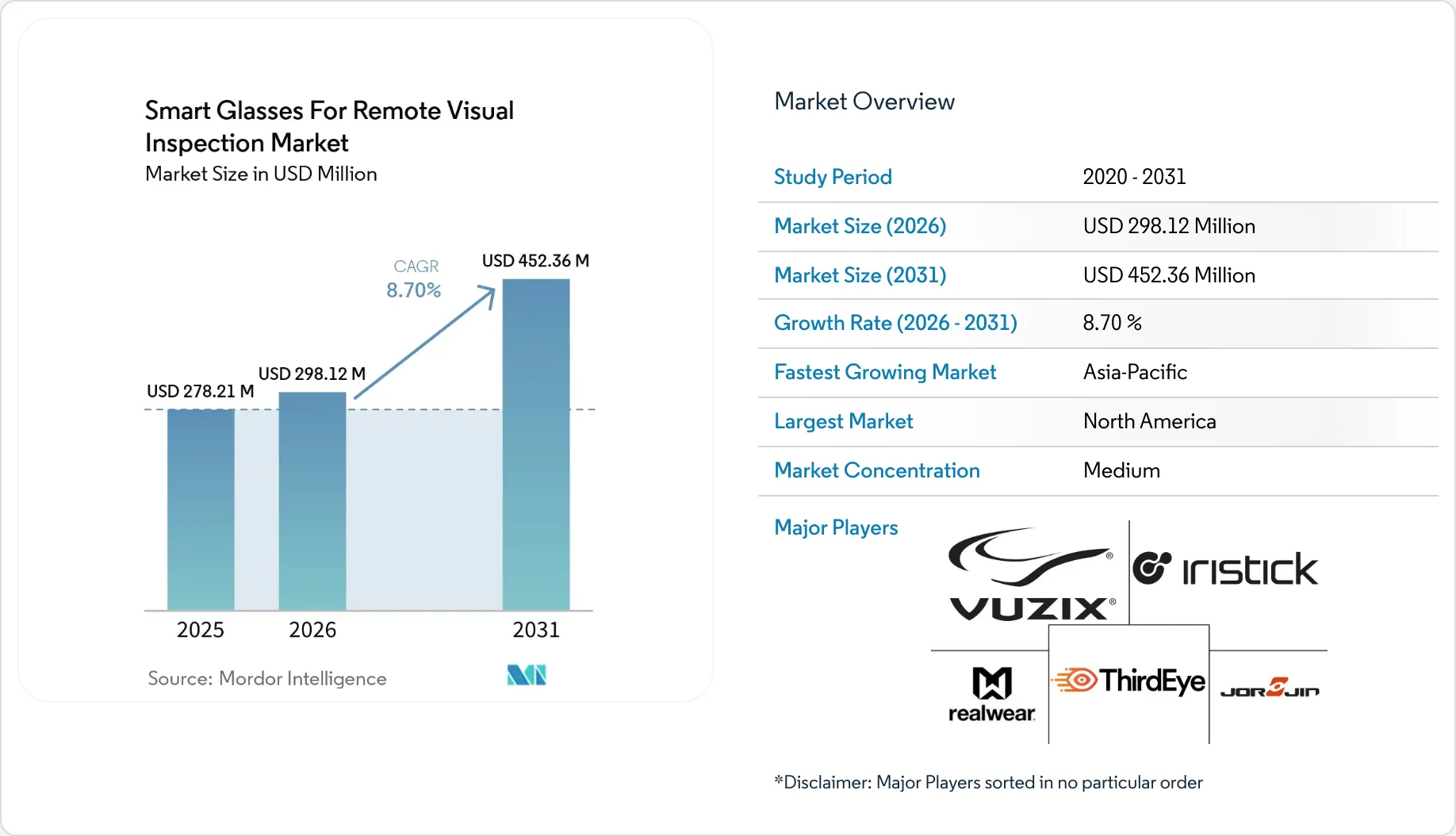
Smart Glasses For Remote Visual Inspection Market Size and ShareMarket Overview
Study Period | 2020 - 2031 |
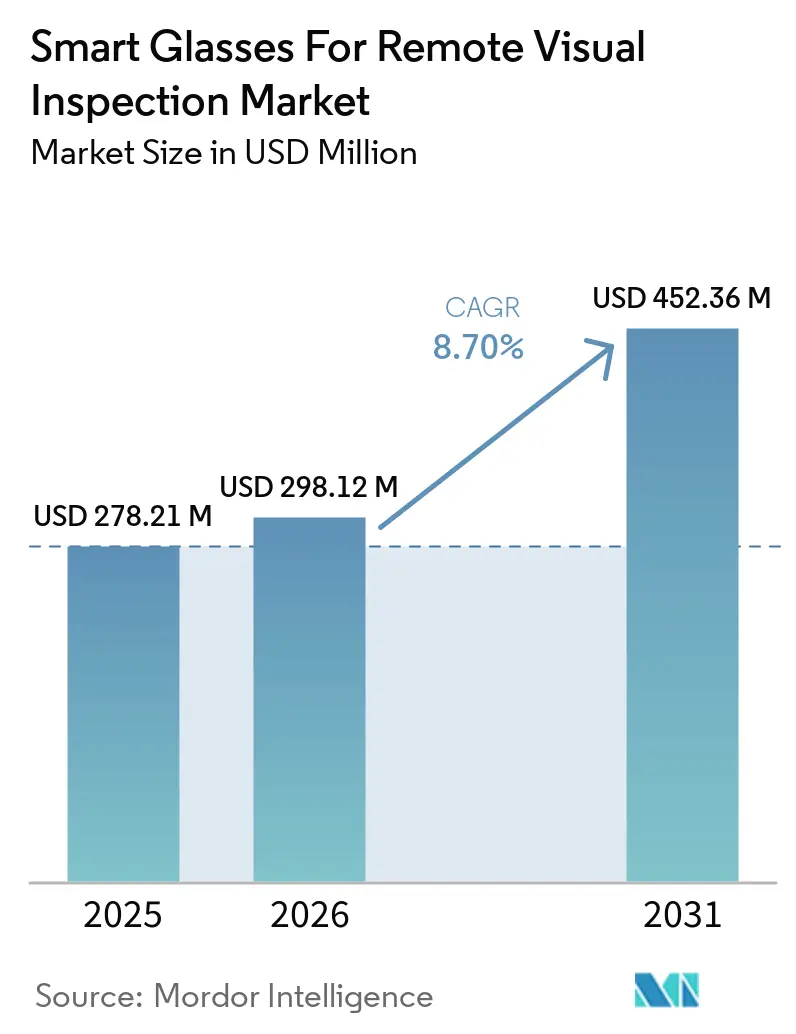
Market Size (2026) | USD 298.12 Million |
Market Size (2031) | USD 452.36 Million |
Growth Rate (2026 - 2031) | 8.70 % |
Fastest Growing Market | Asia-Pacific |
Largest Market | North America |
Market Concentration | Medium |
Major Players*Disclaimer: Major Players sorted in no particular order
Image © Vijeron Intelligence. Reuse requires attribution under CC BY 4.0.
Image © Vijeron Intelligence. Reuse requires attribution under CC BY 4.0.
Section 2
Smart Glasses For Remote Visual Inspection Market Analysis by Vijeron IntelligenceThe Smart Glasses for Remote Visual Inspection Market size was valued at USD 278.21 million in 2025 and estimated to expand from USD 298.12 million in 2026 to reach USD 452.36 million by 2031, at a CAGR of 8.70% during the forecast period (2026-2031). The Smart Glasses for Remote Visual Inspection Market is supported by industrial users moving from paper records and periodic checks to connected, hands-free documentation. Visual proof remains important where sensor readings need confirmation during safety and asset-management processes. Purpose-built, ruggedized platforms are better suited to this work than consumer devices, as inspection work leaves little room for equipment failure. Vendors are also combining computer vision with wearable hardware, which shifts competition toward software integration, data handling, and recurring service models. Supply concentration in optical components and workplace privacy obligations may favor suppliers that can demonstrate compliance and maintain established relationships with component suppliers.
Key Report Takeaways
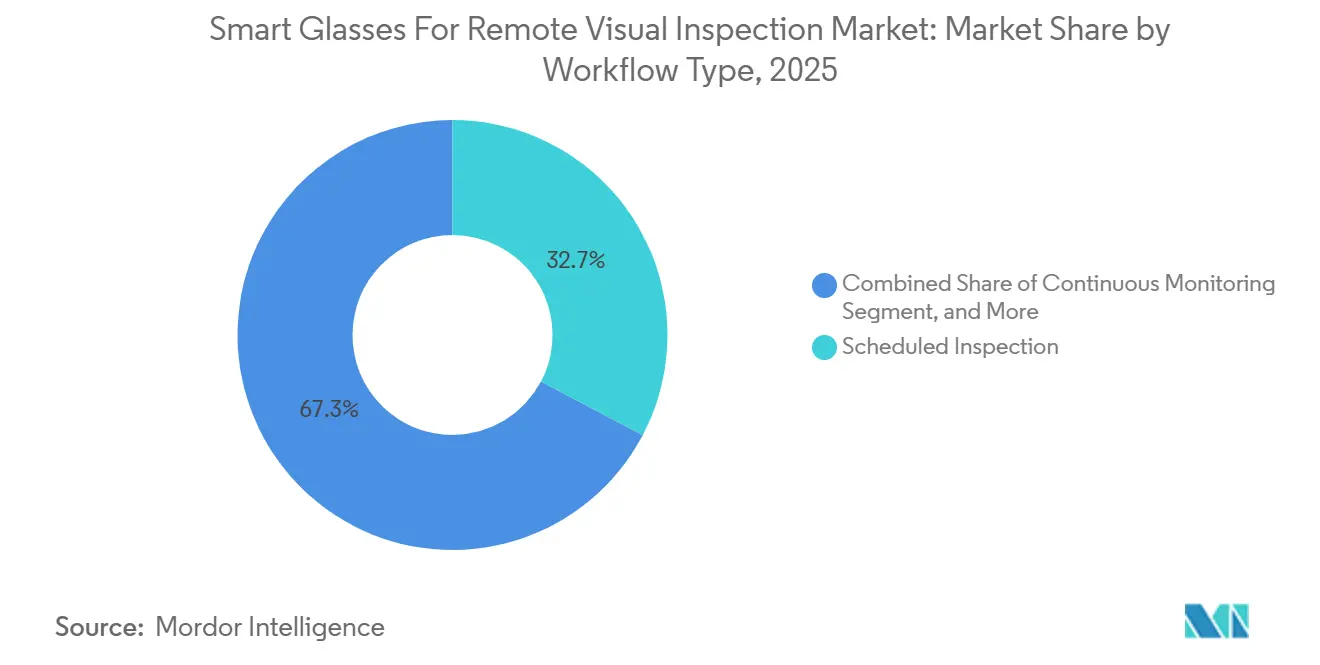
- By workflow type, scheduled inspection held 32.71% of the Smart Glasses for Remote Visual Inspection Market share in 2025, while continuous monitoring is projected to expand at an 11.63% CAGR through 2031.
- By deployment, cloud-based systems accounted for 47.63% of the Smart Glasses for Remote Visual Inspection Market share in 2025 and are projected to expand at a 10.47% CAGR through 2031.
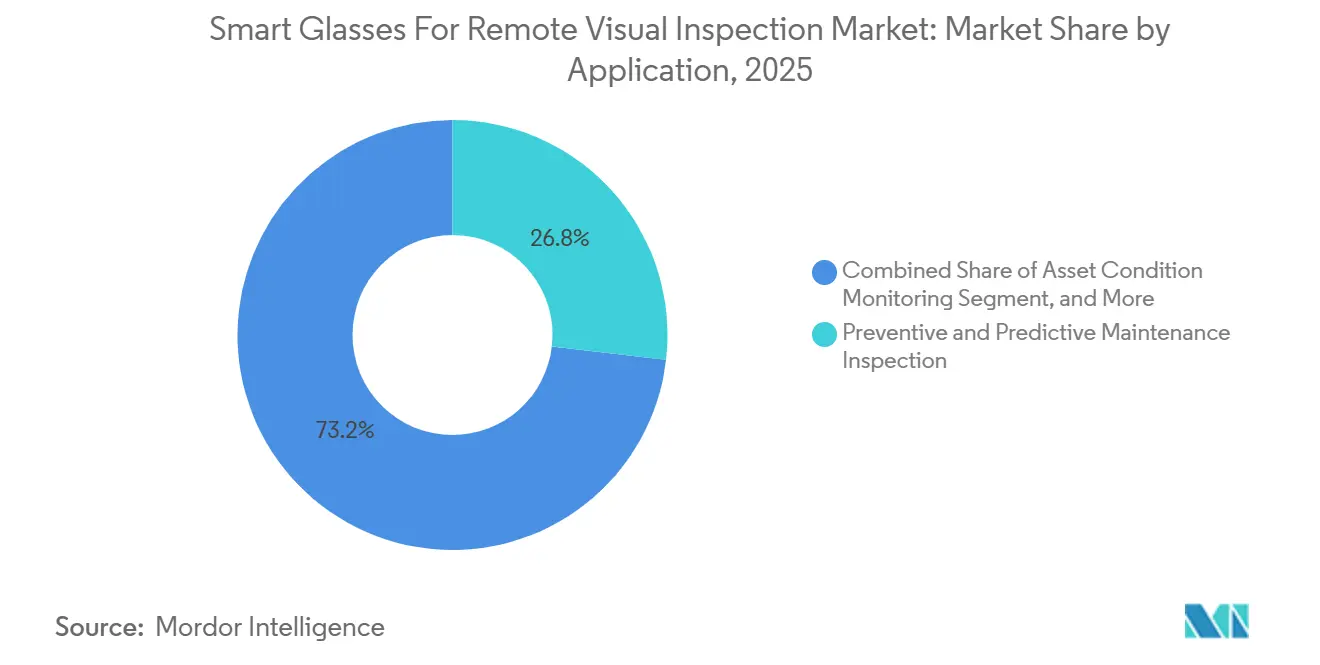
- By application, preventive and predictive maintenance inspection held 26.83% of the Smart Glasses for Remote Visual Inspection Market share in 2025, while asset condition monitoring is projected to expand at an 11.37% CAGR through 2031.
- By end-user industry, manufacturing held 31.47% of the Smart Glasses for Remote Visual Inspection Market share in 2025, while energy and utilities are projected to expand at an 11.83% CAGR through 2031.
- By geography, North America held 35.82% of the Smart Glasses for Remote Visual Inspection Market share in 2025, while Asia-Pacific is projected to expand at an 11.97% CAGR through 2031.
Note: Market size and forecast figures in this report are generated using Vijeron Intelligence’s proprietary estimation framework, updated with the latest available data and insights as of January 2026.
Section 3
Global Smart Glasses For Remote Visual Inspection Market Trends and InsightsDrivers Impact Analysis*
Driver | (~) % Impact on CAGR Forecast | Geographic Relevance | Impact Timeline |
Expansion of Connected Worker Programs | +2.2% | Global, led by North America and Europe | Medium term (2-4 years) |
Need for Hands-Free Inspection and Maintenance | +1.8% | Global, strongest in manufacturing-intensive regions | Short term (≤ 2 years) |
5G and Private Wireless Support for Low-Latency Video | +1.4% | Asia-Pacific, with spillover to Europe and North America | Medium term (2-4 years) |
AI-Based Defect Recognition and Inspection Documentation | +1.1% | Global, strongest in German and Chinese manufacturing | Short term (≤ 2 years) |
Retirement of Experienced Technicians and Remote Knowledge Transfer | +0.7% | North America, Europe, and Japan | Long term (≥ 4 years) |
Ruggedized Smart Glasses in Hazardous Environments | +0.5% | Middle East and Africa, and Asia-Pacific | Medium term (2-4 years) |
Source: Vijeron Intelligence |
Expansion of Connected Worker Programs
Connected worker programs are a central source of demand in the Smart Glasses for Remote Visual Inspection Market because they link devices with work orders, maintenance records, and sensor feeds. The value comes from fitting inspection evidence into existing operating processes, rather than from a headset alone. Organizations that already use digital work-order systems can more easily move from pilots to larger deployments. Airbus deployed private 5G with Ericsson at its Hamburg and Toulouse sites in 2025 to support connected-factory use cases, including augmented-reality inspections and predictive maintenance. AcuraFlow expanded its Vuzix M400 deployment to more than 900 units across North America in April 2026, showing that modular hardware and software programs can extend beyond initial trials. Larger deployments can create internal operating evidence that reduces the time needed to approve later installations.
Increasing Need for Hands-Free Inspection and Maintenance
Hands-free inspection is most important when technicians must handle tools, review instructions, and communicate simultaneously. These tasks can raise errors and safety risks in older industrial facilities. A 2025 oilfield study reported 93.6% anomaly-detection accuracy, a 41.7% reduction in individual inspection time, and emergency response time reduced to 28% of baseline with an intelligent-glasses system.[1]Design and Practical Application of Intelligent Glasses in Oilfield Stations,” Applied Technology in Distributed Energy Systems, doi.org. The study also reported annual operating-cost reductions of CNY 4.4 million (USD 607,000) per station. Manufacturing users have also reported better first-time-fix results and fewer procedural errors, although outcomes differ by workflow and deployment setting. This supports adoption in locations where the cost of an error or outage exceeds the cost of wearable equipment.
5G and Private Wireless Networks Enabling Low-Latency Video Support
Private 5G and campus wireless networks address a key operating limitation for the Smart Glasses for Remote Visual Inspection Market, the need for live video in industrial locations with limited bandwidth. These networks can move intensive video processing from the headset to edge or cloud systems. A 2024 study of industrial augmented reality reduced end-to-end latency from 78 milliseconds to 45 milliseconds through a device-edge-cloud model. The same study reported 67% compression of 4K video while defect-recognition accuracy remained above 99%. CIMPOR used Ericsson Private 5G across 3 Portuguese production units for remote maintenance applications with sub-10-millisecond latency. These deployments make persistent visual workflows more practical when reliable connectivity is available at the worksite.[2]Demo: Paving the Way for Smart Manufacturing with 5G/TSN Convergence and Augmented Reality,” IEEE CSCN, doi.org.
AI-Based Defect Recognition and Inspection Documentation
Artificial intelligence is changing the Smart Glasses for Remote Visual Inspection Market from a communication-focused category to one that also supports detection and documentation. Vuzix and Wyr.ai launched an inspection platform for the Vuzix M400 in June 2025, featuring automated defect detection, barcode scanning, color matching, and optical character recognition. A 2024 study assessed YOLOv8 image recognition through smart-glasses camera feeds during assembly inspection. It found that combining mixed reality and computer vision improved the speed and reliability of defect detection.[3]Validating the Use of Smart Glasses in Industrial Quality Control: A Case Study,” Applied Sciences, mdpi.com. Recorded inspection results can also provide labeled data to improve the recognition model over time. Larger deployments may therefore have an advantage, as they generate more operational data within a defined use case.
Restraints Impact Analysis*
Restraint | (~) % Impact on CAGR Forecast | Geographic Relevance | Impact Timeline |
Battery Runtime and Wearability Limits During Full Shifts | -1.8% | Global | Short term (≤ 2 years) |
Data Protection and Worker Privacy Concerns | -1.4% | Europe, and North America | Medium term (2-4 years) |
Integration Costs for MES, CMMS, ERP, and Legacy Systems | -0.9% | Global, especially legacy-heavy industries | Long term (≥ 4 years) |
Optical Waveguide, Microdisplay, and Camera Supply Constraints | -0.7% | Global, concentrated in Asia-Pacific production hubs | Medium term (2-4 years) |
Source: Vijeron Intelligence |
Battery Runtime and Wearability Limitations During Full-Shift Operations
Battery life and comfort remain practical limits for the Smart Glasses for Remote Visual Inspection Market. Industrial glasses typically provide 2.5 to 4 hours of runtime during continuous voice and video use, compared with an 8 to 12-hour shift. Organizations may need 2 to 3 battery units or hot-swappable devices for each worker to avoid interruptions. This can add 50% to 80% to ownership costs beyond the initial device purchase. A 2024 logistics study found that external battery packs were required for full-shift use and raised unresolved questions about long-term eye strain. Newer devices are addressing this constraint, but operations in hazardous zones still require controlled battery handling and suitable certification.
Data Protection and Worker Privacy Concerns
Workplace video and biometric data can lengthen deployment reviews in the Smart Glasses for Remote Visual Inspection Market. Continuous video capture may trigger data-protection requirements when recordings identify workers or other individuals. AI-enabled recognition functions can add further compliance obligations in Europe under the EU AI Act. In North America, biometric information rules, including Illinois BIPA and California CCPA requirements, can apply when devices capture facial geometry or voiceprints. Legal and privacy reviews may extend procurement cycles by 3 to 6 months in European jurisdictions. Suppliers with established documentation and configurable data controls are better placed to address these requirements.
*Our forecasts treat driver/restraint impacts as directional, not additive. The impact forecasts reflect baseline growth, mix effects, and variable interactions.
Section 4
Segment AnalysisBy Workflow Type: Continuous Monitoring Reshapes Inspection Infrastructure
Scheduled inspection held 32.71% of the Smart Glasses for Remote Visual Inspection Market in 2025 because asset-heavy operations commonly follow time-based maintenance plans. Oil and gas, power generation, and heavy manufacturing use defined routes and checklist-based procedures, which smart glasses can display in a technician’s field of view. This reduces reliance on paper forms and later data entry while keeping the inspection sequence visible at the point of work. Event-triggered inspection enables unplanned maintenance following a sensor alert or operational issue. Emergency and breakdown response also benefits from hands-free communication when technicians must maintain their attention and safety posture.
Continuous monitoring is projected to expand at an 11.63% CAGR from 2026 to 2031, the highest rate within the workflow segment. It combines always-on sensor data with visual checks that sensor data alone cannot provide, adding a persistent layer rather than replacing scheduled inspections. The model requires reliable connectivity, video-record storage, and analytics that can handle large volumes of footage without constant manual review. An IEEE demonstration showed that augmented-reality remote assistance could operate over hybrid TSN and 5G systems for sustained industrial work. This approach can shift buyer spending from isolated inspections toward site-level services that combine bandwidth, storage, and analytics.
Image © Vijeron Intelligence. Reuse requires attribution under CC BY 4.0. By Deployment: Cloud Systems Support Broader Enterprise Rollouts
Cloud-based deployment accounted for 47.63% of the Smart Glasses for Remote Visual Inspection Market share in 2025 and is projected to expand at a 10.47% CAGR through 2031. It is the largest and fastest-expanding deployment option, indicating stronger enterprise acceptance of cloud security and latency controls for inspection work. Cloud delivery can simplify remote expert access, central device administration, and retention of inspection material across locations. Vuzix introduced Solutions kits in February 2026 with M400 or LX1 hardware and native Microsoft Teams and Zoom applications. Preconfigured kits can reduce integration work and shorten deployment time for organizations without dedicated augmented-reality teams.
On-premise systems remain important in defense, nuclear operations, and regulated pharmaceutical settings where inspection video may need to remain within the company infrastructure. Hybrid models combine cloud-managed device administration with local video retention, which is relevant for European operators subject to data-residency obligations. A 2024 private wireless study stated that augmented-reality worker-assistance use cases require more than 50 Mbps bandwidth and latency below 20 milliseconds. This network profile can be met through cloud-edge hybrid architectures that use private 5G at production scale. Platforms that define data location and processing rules for each deployment offer a clearer path across these operating environments.
By Application: Asset Condition Monitoring Increases Recurring Use
Preventive and predictive maintenance inspections accounted for 26.83% of the Smart Glasses for Remote Visual Inspection Market share in 2025, supported by established predictive maintenance programs at industrial sites. Wearable video helps workers determine whether a sensor alert requires immediate action or a scheduled repair, helping avoid unnecessary interventions and unplanned downtime. Quality control, safety checks, remote expert support, field service, and facility inspection are additional applications. Each uses clear video, low-delay annotation, and records that can connect to defined operating procedures. The shared requirement is a documented visual check that can be reviewed after work is completed.
Asset condition monitoring is projected to expand at an 11.37% CAGR from 2026 to 2031, supporting recurring use through ongoing asset records rather than isolated service events. EON Reality introduced Field IQ in June 2026, featuring step-by-step procedures, photo verification, and audit trails via Meta Ray-Ban Display smart glasses. The product embeds visual evidence within compliance documentation and records the required evidence at each stage of work. Formal asset-management practices further increase the need for condition records that can be audited over time. This creates a stronger case for deployment where inspection history supports continuing decisions about critical equipment.
Image © Vijeron Intelligence. Reuse requires attribution under CC BY 4.0. By End-User Industry: Energy and Utilities Respond to Workforce Pressures
Manufacturing held 31.47% of the Smart Glasses for Remote Visual Inspection Market share in 2025, reflecting adoption for process checks and remote support across automotive, electronics, aerospace, and precision manufacturing. The Smart Glasses for Remote Visual Inspection Industry serve different use cases across these settings, all of which require reliable visual evidence. A 2025 proof of concept by Berise and Interface combined smart glasses with a digital twin platform and reported a 95% reduction in manager status-monitoring time. Construction, logistics, mining, healthcare, public safety, and government also use documented visual evidence for selected inspection work. Adoption in these settings depends on hardware suitability, network availability, and site-specific demands.
Energy and utilities are projected to expand at an 11.83% CAGR from 2026 to 2031, as up to 50% of the utility workforce is expected to retire within the next 5 to 10 years. Liaoning Hongyanhe Nuclear Power deployed an augmented-reality smart glasses system in July 2026 that streams first-person video, adds thermal imaging, recognizes nameplates, and produces records for safety review. Within the Smart Glasses for Remote Visual Inspection Market, this type of use helps remote specialists transfer knowledge during instrument maintenance and supports the creation of traceable operating records. Oil and gas, petrochemical, and mining users also need equipment that meets ATEX Zone 1 and IECEx requirements. Within the Smart Glasses for Remote Visual Inspection Market, these requirements distinguish industrial systems from consumer products and can limit the pool of eligible suppliers.
Section 5
Geography Analysis
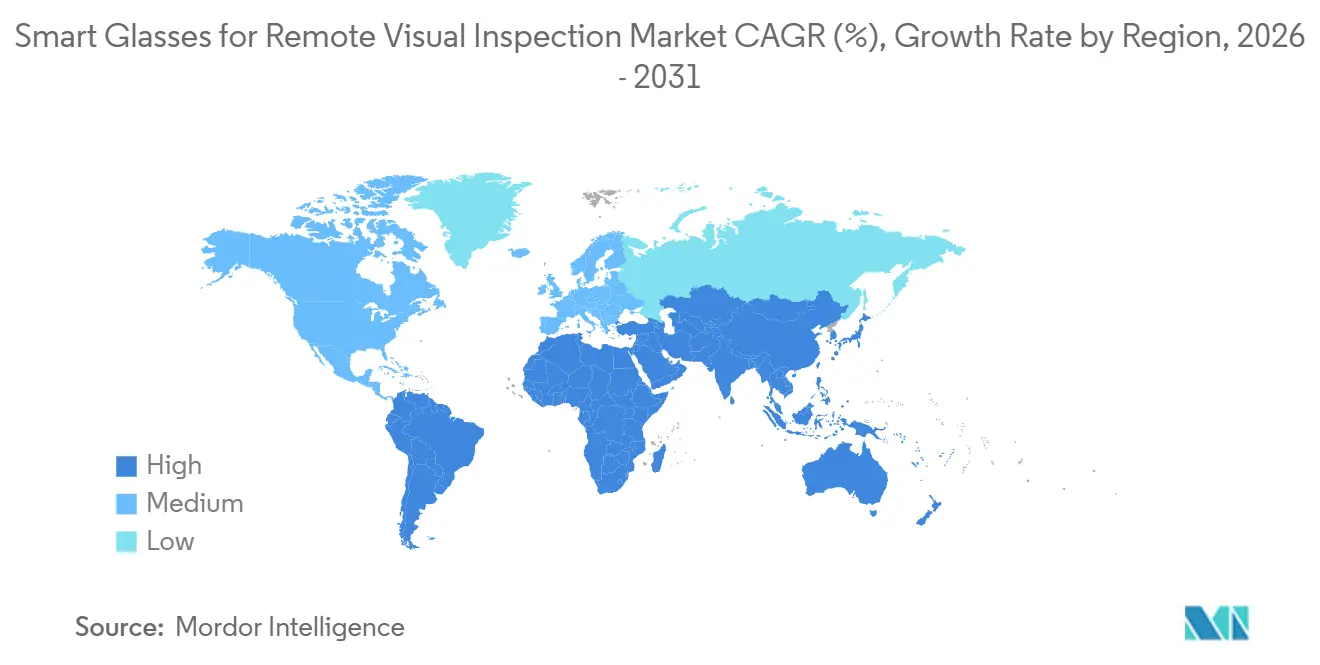
North America held 35.82% of the Smart Glasses for Remote Visual Inspection Market share in 2025, supported by established digitalization budgets and a sizable base of connected industrial facilities. Demand is concentrated in the United States in manufacturing, oil and gas, and logistics, where connected worker programs begun between 2020 and 2025 are moving from trials to wider operational use. AcuraFlow expanded to more than 900 Vuzix M400 units in North America in April 2026. A global retailer also extended Vuzix deployments into server infrastructure and robotics applications during March 2026. Canada and Mexico have smaller, developing adoption bases in mining and energy extraction.
Europe is the second-largest regional market, with Germany, the United Kingdom, and France leading use in aerospace, utilities, and industrial manufacturing. Data-protection obligations can slow procurement because vendors need to demonstrate data-governance measures, but they also raise the qualification threshold for new suppliers. Asia-Pacific is projected to expand at an 11.97% CAGR from 2026 to 2031, supported by Chinese industrial modernization, Japan’s maintenance-workforce needs, and smart-factory investment in South Korea and India. China Telecom and ZTE developed a 5G-A MobileTurbo platform that combines cloud, edge, and end AI for low-latency augmented-reality streaming from field workers to remote experts.
China Southern Power Grid Research Institute completed verification of industrial AI glasses for power infrastructure inspection in June 2026. Hitachi Construction Machinery, HMS, and Holo-Light presented ruggedized XR smart glasses for construction and mining service work in 2025.[4]Hitachi Construction Machinery, HMS, and Holo-Light Develop Ruggedized XR Smart Glasses for Construction and Mining Sites,” Hitachi Construction Machinery, hitachicm.com. Middle East and Africa activity focuses on oil, gas, and petrochemical inspection programs, while SABA Drilling has developed its IP68-rated SmartLens for pipeline inspection, equipment monitoring, and remote expert collaboration. South America remains in its early stages, with Brazil and Argentina exploring mining and infrastructure use cases. Limited private 5G coverage outside major industrial areas can extend deployment schedules, although investment in Brazil’s industrial southeast is starting to narrow this gap.
Image © Vijeron Intelligence. Reuse requires attribution under CC BY 4.0.
Section 6
Competitive Landscape
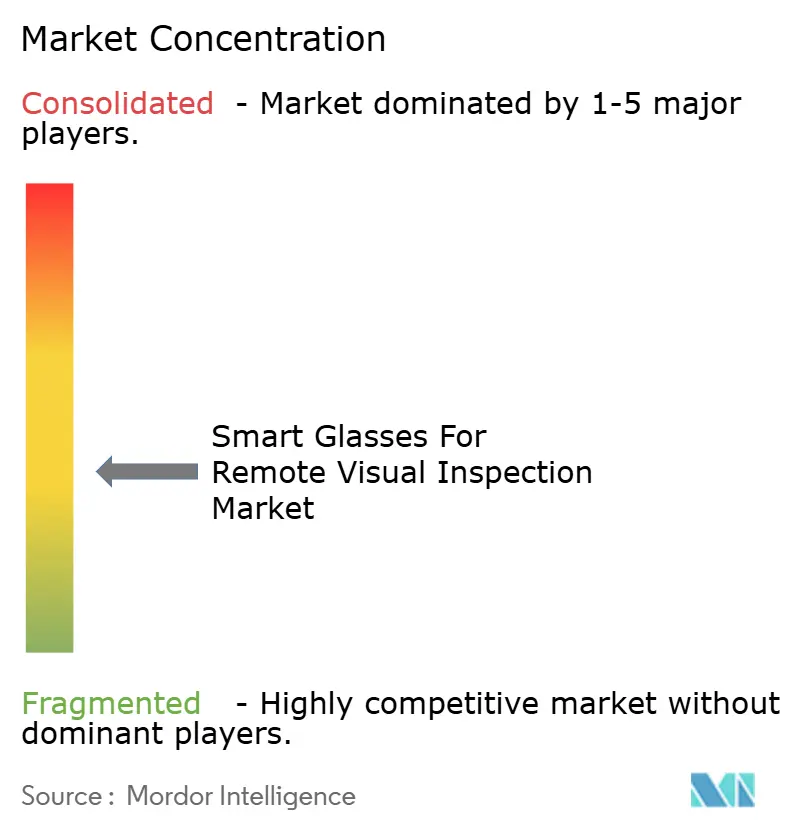
The Smart Glasses for Remote Visual Inspection Market is moderately fragmented around purpose-built industrial platform suppliers, led by RealWear and Vuzix, which have enterprise relationships in regulated settings. Their positions rest on rugged hardware, software ecosystems, and validated deployments that are difficult for newer suppliers to match. Competition is increasingly based on artificial intelligence, enterprise integrations, and subscription-oriented delivery, which can create recurring revenue and increase switching costs. RealWear introduced the Arc 3 and Ari OS in October 2025. Ari OS represents a move toward a voice-first system that could be licensed to other device manufacturers.
Vuzix has focused on simplifying enterprise onboarding through packaged deployment options, including its February 2026 Solutions kits, which include ruggedized glasses and preconfigured collaboration applications. This strategy targets mid-sized manufacturing sites that have funds for inspection tools but limited resources for complex technology rollouts. EON Reality entered this space with Field IQ in June 2026, combining procedures, visual verification, and audit records. VITURE introduced Helix AI Safety Glasses at AWE 2026 with NVIDIA XR AI and ANSI Z87.1-2025 safety-glasses engineering. These moves show that configuration and implementation support are becoming as important as the wearable hardware itself.
Lumus and Quanta Computer signed a licensing agreement in September 2026 for thinner, lower-cost geometric waveguides. Higher-volume production can support lighter device designs across the supplier base, while IEC 60068 environmental requirements remain a hurdle for new suppliers targeting mining, oil and gas, and chemical-processing sites. The Smart Glasses for Remote Visual Inspection Market rewards vendors that combine hardware durability, integrated software, and documentation suited to regulated customers. These conditions favor established platforms while still leaving openings for specialized providers that simplify field deployment.
Smart Glasses For Remote Visual Inspection Industry Leaders* RealWear, Inc.
- Vuzix Corporation
- Iristick NV
- Jorjin Technologies Inc
- ThirdEye Gen, Inc.
- *Disclaimer: Major Players sorted in no particular order
Image © Vijeron Intelligence. Reuse requires attribution under CC BY 4.0.
Section 7
Recent Industry Developments* September 2026: Lumus and Quanta Computer signed a licensing agreement for next-generation thinner, lower-cost geometric waveguides for AR glasses. Quanta will manufacture the waveguides at scale, directly improving supply chain capacity for lightweight industrial smart glasses used in enterprise inspection deployments and enabling higher-volume market access.
- August 2026: Vuzix received a follow-on smart glasses order from Augmex, a European enterprise solutions provider, supporting Augmex's US market launch with Vuzix M400 and LX1 devices. The order extends a supply partnership initiated in December 2024, reflecting the geographic expansion of enterprise smart glasses deployment from Europe into North America.
- July 2026: Liaoning Hongyanhe Nuclear Power Co. (a CGN affiliate) deployed an AR smart glasses system for on-site instrument maintenance. The system enables real-time video streaming to backend experts, thermal imaging overlay for equipment temperature monitoring, automatic nameplate recognition, and traceable digital work records for quality control and compliance.
- June 2026: VITURE unveiled the Helix AI Safety Glasses at AWE 2026, the first AI safety glasses built on NVIDIA XR AI, developed with Stanford and Princeton research labs. The device features a 12MP first-person camera and is engineered to ANSI Z87.1-2025, targeting pharmaceutical, clinical, and industrial inspection without additional PPE requirement.
Section 8
Table of Contents for Smart Glasses For Remote Visual Inspection Industry Report1. INTRODUCTION
- 1.1 Study Assumptions and Market Definition
- 1.2 Scope of the Study
- RESEARCH METHODOLOGY
- EXECUTIVE SUMMARY
- MARKET LANDSCAPE
- 4.1 Market Overview
- 4.2 Market Drivers* 4.2.1 Expansion of Connected Worker Programs
- 4.2.2 Increasing Need for Hands-Free Inspection and Maintenance
- 4.2.3 5G and Private Wireless Networks Enabling Low-Latency Video Support
- 4.2.4 AI-Based Defect Recognition and Inspection Documentation
- 4.2.5 Retirement of Experienced Technicians and Remote Knowledge Transfer
- 4.2.6 Rising Adoption of Ruggedized Smart Glasses in Hazardous Environments
- 4.3 Market Restraints* 4.3.1 Battery Runtime and Wearability Limitations During Full-Shift Operations
- 4.3.2 Data-Protection and Worker-Privacy Concerns
- 4.3.3 Integration Costs Across MES, CMMS, ERP, and Legacy Inspection Systems
- 4.3.4 Optical Waveguide, Microdisplay, and Specialized Camera Supply Constraints
- 4.4 Impact of Macroeconomic Factors on the Market
- 4.5 Industry Supply-Chain Analysis
- 4.6 Technology Outlook
- 4.7 Regulatory Landscape
- 4.8 Porter’s Five Forces Analysis* 4.8.1 Threat of New Entrants
- 4.8.2 Bargaining Power of Suppliers
- 4.8.3 Bargaining Power of Buyers
- 4.8.4 Threat of Substitutes
- 4.8.5 Intensity of Competitive Rivalry
- MARKET SIZE AND GROWTH FORECASTS (VALUE)
- 5.1 By Workflow Type* 5.1.1 Scheduled Inspection
- 5.1.2 Event-Triggered Inspection
- 5.1.3 Continuous Monitoring
- 5.1.4 Emergency and Breakdown Response
- 5.2 By Deployment* 5.2.1 Cloud-Based Deployment
- 5.2.2 On-Premise Deployment
- 5.2.3 Hybrid Deployment
- 5.3 By Application* 5.3.1 Preventive and Predictive Maintenance Inspection
- 5.3.2 Quality Control and Defect Inspection
- 5.3.3 Safety and Compliance Inspection
- 5.3.4 Asset Condition Monitoring
- 5.3.5 Infrastructure and Facility Inspection
- 5.3.6 Other Applications
- 5.4 By End-User Industry* 5.4.1 Manufacturing
- 5.4.2 Energy and Utilities
- 5.4.3 Construction and Infrastructure
- 5.4.4 Transportation and Logistics
- 5.4.5 Healthcare and Life Sciences
- 5.4.6 Public Safety and Government
- 5.4.7 Other End-User Industries
- 5.5 By Geography* 5.5.1 North America
- 5.5.1.1 United States
- 5.5.1.2 Canada
- 5.5.1.3 Mexico
- 5.5.2 South America
- 5.5.2.1 Brazil
- 5.5.2.2 Argentina
- 5.5.2.3 Rest of South America
- 5.5.3 Europe
- 5.5.3.1 Germany
- 5.5.3.2 United Kingdom
- 5.5.3.3 France
- 5.5.3.4 Italy
- 5.5.3.5 Spain
- 5.5.3.6 Rest of Europe
- 5.5.4 Asia-Pacific
- 5.5.4.1 China
- 5.5.4.2 Japan
- 5.5.4.3 India
- 5.5.4.4 South Korea
- 5.5.4.5 Rest of Asia-Pacific
- 5.5.5 Middle East and Africa
- 5.5.5.1 Middle East
- 5.5.5.1.1 Saudi Arabia
- 5.5.5.1.2 United Arab Emirates
- 5.5.5.1.3 Turkey
- 5.5.5.1.4 Rest of the Middle East
- 5.5.5.2 Africa
- 5.5.5.2.1 South Africa
- 5.5.5.2.2 Nigeria
- 5.5.5.2.3 Rest of Africa
- COMPETITIVE LANDSCAPE
- 6.1 Market Concentration
- 6.2 Strategic Moves
- 6.3 Market Share Analysis
- 6.4 Company Profiles (includes Global Level Overview, Market Level Overview, Core Segments, Financials as available, Strategic Information, Market RankandShare, Products and Services, Recent Developments)* 6.4.1 RealWear, Inc.
- 6.4.2 Vuzix Corporation
- 6.4.3 Iristick NV
- 6.4.4 ThirdEye Gen, Inc.
- 6.4.5 Almer Technologies AG
- 6.4.6 DigiLens Inc.
- 6.4.7 Jorjin Technologies Inc.
- 6.4.8 Goolton Technology Co., Ltd.
- 6.4.9 Rokid Corporation Ltd.
- 6.4.10 XREAL Technology Limited
- 6.4.11 Magic Leap, Inc.
- 6.4.12 Moziware, Inc.
- 6.4.13 HMS Industrial Networks AB
- 6.4.14 ActiveLook SAS
- 6.4.15 AMA Corporation
- 6.4.16 Optinvent SA
- 6.4.17 Augumenta Oy
- 6.4.18 Kognitiv Spark Corporation
- 6.4.19 Kopin Corporation
- 6.4.20 Lumus Ltd.
- MARKET OPPORTUNITIES AND FUTURE OUTLOOK
- 7.1 White-Space and Unmet-Need Assessment
Section 9
Global Smart Glasses For Remote Visual Inspection Market Report ScopeSmart Glasses for Remote Visual Inspection are wearable augmented reality devices equipped with high-definition cameras, real-time streaming capabilities, and collaboration software that enable off-site experts to guide on-site personnel through visual inspections, maintenance tasks, and quality checks, thereby enhancing operational efficiency and reducing travel costs.
The Smart Glasses for Remote Visual Inspection Market Report is Segmented by Workflow Type (Scheduled Inspection, Event-Triggered Inspection, Continuous Monitoring, and Emergency and Breakdown Response), Deployment (Cloud-Based Deployment, On-Premise Deployment, and Hybrid Deployment), Application (Remote Expert Assistance, Preventive and Predictive Maintenance Inspection, Quality Control and Defect Inspection, Safety and Compliance Inspection, Asset Condition Monitoring, Field Service and Repair Inspection, Infrastructure and Facility Inspection, and Other Applications), End-User Industry (Manufacturing, Energy and Utilities, Construction and Infrastructure, Mining and Metals, Transportation and Logistics, Healthcare and Life Sciences, Public Safety and Government, Industrial Machinery and Heavy Equipment, Logistics and Warehousing, and Other End-User Industries), and Geography (North America, South America, Europe, Asia-Pacific, Middle East and Africa). The Market Forecasts are Provided in Terms of Value (USD).
By Workflow TypeScheduled Inspection |
Event-Triggered Inspection |
Continuous Monitoring |
Emergency and Breakdown Response |
By DeploymentCloud-Based Deployment |
On-Premise Deployment |
Hybrid Deployment |
By ApplicationPreventive and Predictive Maintenance Inspection |
Quality Control and Defect Inspection |
Safety and Compliance Inspection |
Asset Condition Monitoring |
Infrastructure and Facility Inspection |
Other Applications |
By End-User IndustryManufacturing |
Energy and Utilities |
Construction and Infrastructure |
Transportation and Logistics |
Healthcare and Life Sciences |
Public Safety and Government |
Other End-User Industries |
By GeographyNorth America | United States |
| Canada |
|---|
| Mexico |
South America | Brazil |
| Argentina |
|---|
| Rest of South America |
Europe | Germany |
| United Kingdom |
|---|
| France |
| Italy |
| Spain |
| Rest of Europe |
Asia-Pacific | China |
| Japan |
|---|
| India |
| South Korea |
| Rest of Asia-Pacific |
Middle East and Africa | Middle East | Saudi Arabia |
| United Arab Emirates | |
|---|---|
| Turkey | |
| Rest of the Middle East | |
| Africa | South Africa |
| Nigeria | |
| Rest of Africa |
By Workflow Type | Scheduled Inspection |
| Event-Triggered Inspection |
|---|
| Continuous Monitoring |
| Emergency and Breakdown Response |
By Deployment | Cloud-Based Deployment |
| On-Premise Deployment |
|---|
| Hybrid Deployment |
By Application | Preventive and Predictive Maintenance Inspection |
| Quality Control and Defect Inspection |
|---|
| Safety and Compliance Inspection |
| Asset Condition Monitoring |
| Infrastructure and Facility Inspection |
| Other Applications |
By End-User Industry | Manufacturing |
| Energy and Utilities |
|---|
| Construction and Infrastructure |
| Transportation and Logistics |
| Healthcare and Life Sciences |
| Public Safety and Government |
| Other End-User Industries |
By Geography | North America | United States |
| Canada | ||
|---|---|---|
| Mexico | ||
| South America | Brazil | |
| Argentina | ||
| Rest of South America | ||
| Europe | Germany | |
| United Kingdom | ||
| France | ||
| Italy | ||
| Spain | ||
| Rest of Europe | ||
| Asia-Pacific | China | |
| Japan | ||
| India | ||
| South Korea | ||
| Rest of Asia-Pacific | ||
| Middle East and Africa | Middle East | Saudi Arabia |
| United Arab Emirates | ||
| Turkey | ||
| Rest of the Middle East | ||
| Africa | South Africa | |
| Nigeria | ||
| Rest of Africa |
Section 10
Key Questions Answered in the ReportWhat is the Smart Glasses for Remote Visual Inspection Market size? The Smart Glasses for Remote Visual Inspection Market was valued at USD 278.21 million in 2025, is estimated at USD 298.12 million in 2026, and is projected to reach USD 452.36 million by 2031.
What is driving adoption of smart glasses for remote visual inspection? Connected worker programs, hands-free maintenance, private wireless networks, and artificial intelligence-based documentation are supporting deployment.
Which workflow is expanding fastest? Continuous monitoring is projected to expand at an 11.63% CAGR through 2031, while scheduled inspection held the largest 2025 workflow share.
Why do industrial users choose cloud-based deployment? Cloud-based systems held 47.63% share in 2025 and can support centralized device management, remote expert access, and retained inspection records.
Which end-user sector is expanding fastest? Energy and utilities are projected to expand at an 11.83% CAGR through 2031, supported by knowledge-transfer needs and certified inspection requirements.
Which region is projected to expand fastest? Asia-Pacific is projected to expand at an 11.97% CAGR through 2031, supported by industrial modernization and smart-factory investment.