Europe Optical Transponder Market Size & Share Analysis - Growth Trends and Forecast (2026 - 2031)
Europe Optical Transponder Market Size & Share Analysis - Growth Trends and Forecast (2026 - 2031)
Industry: Technology, Media & Telecom (TMT)
Source: https://www.mordorintelligence.com/industry-reports/europe-optical-transponder-market
Scraped Date: 2026-09-17
Key Market Estimates
| Variable | Value | Unit |
|---|
| Base Year Market Size (2025) | 1.55 | USD Billion |
|---|
| Market Size (2026) | 1.69 | USD Billion |
|---|
| Market Size (2031) | 2.38 | USD Billion |
|---|
| Growth Rate (2026 - 2031) | 7.09 | PERCENT |
|---|
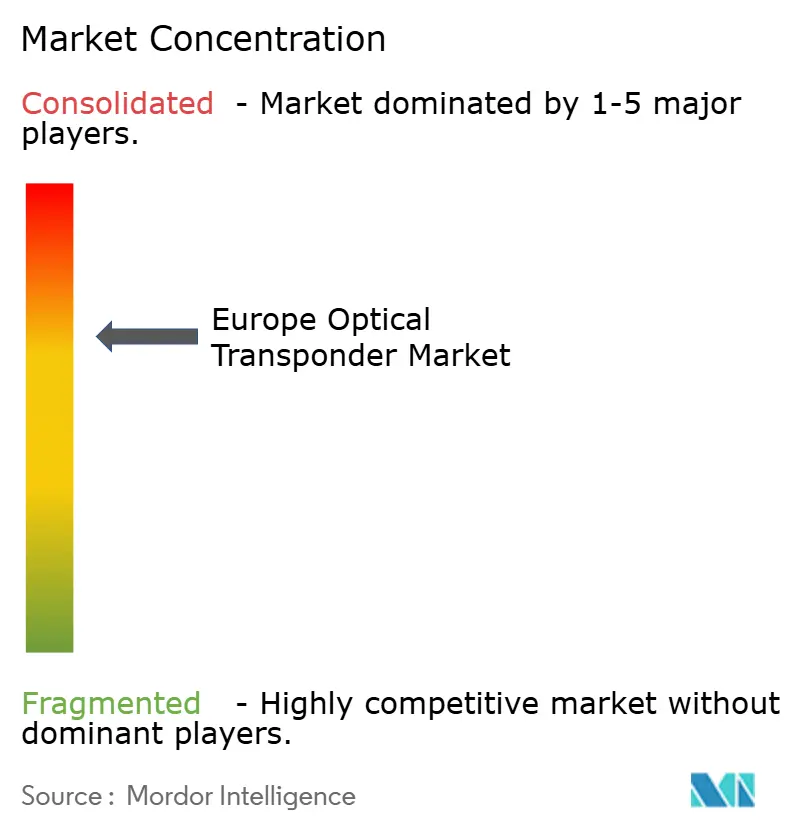
| Market Concentration | Medium |
|---|

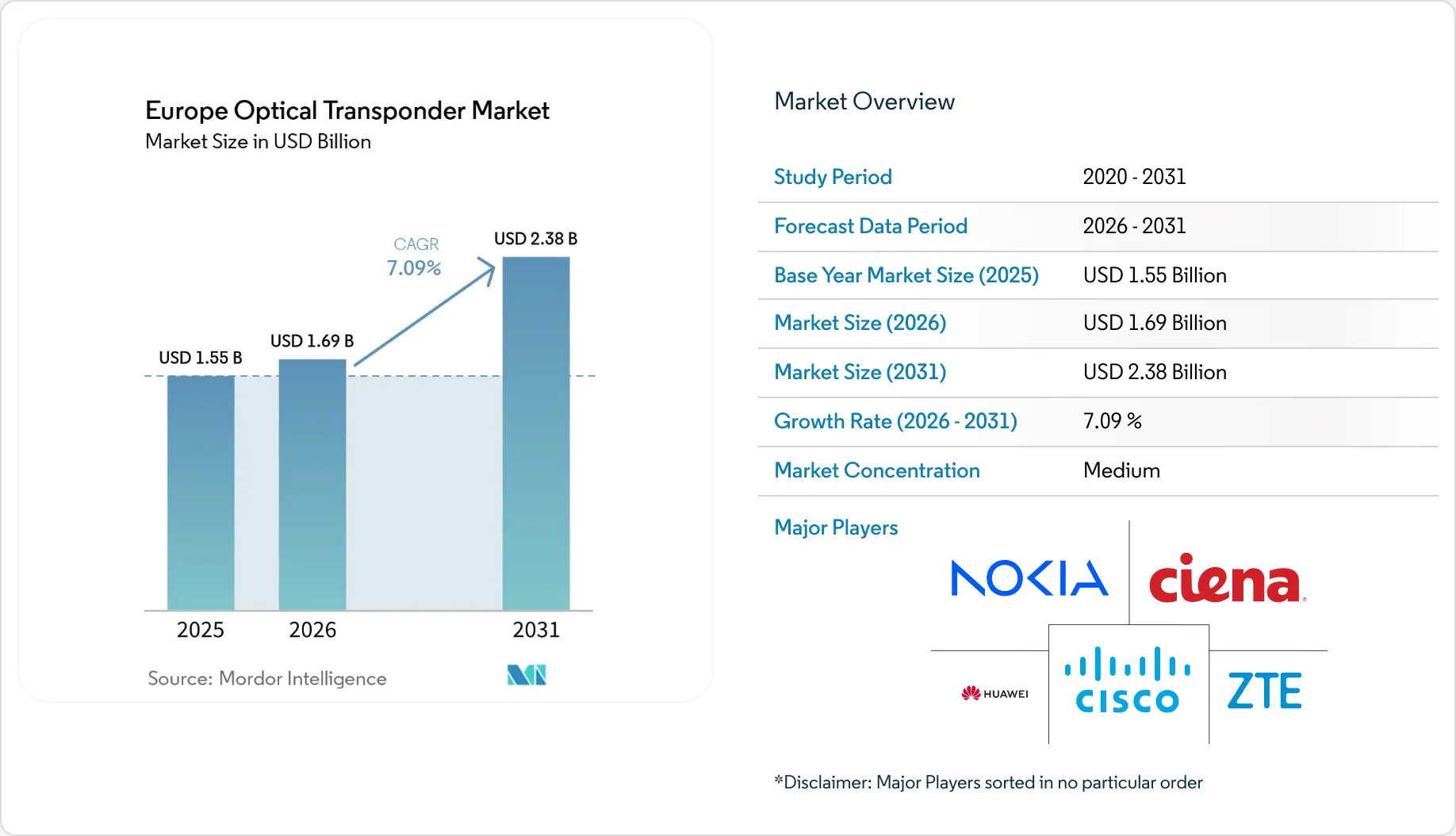



Section 1
Europe Optical Transponder Market Size and ShareMarket Overview
Study Period | 2020 - 2031 |
Forecast Data Period | 2026 - 2031 |
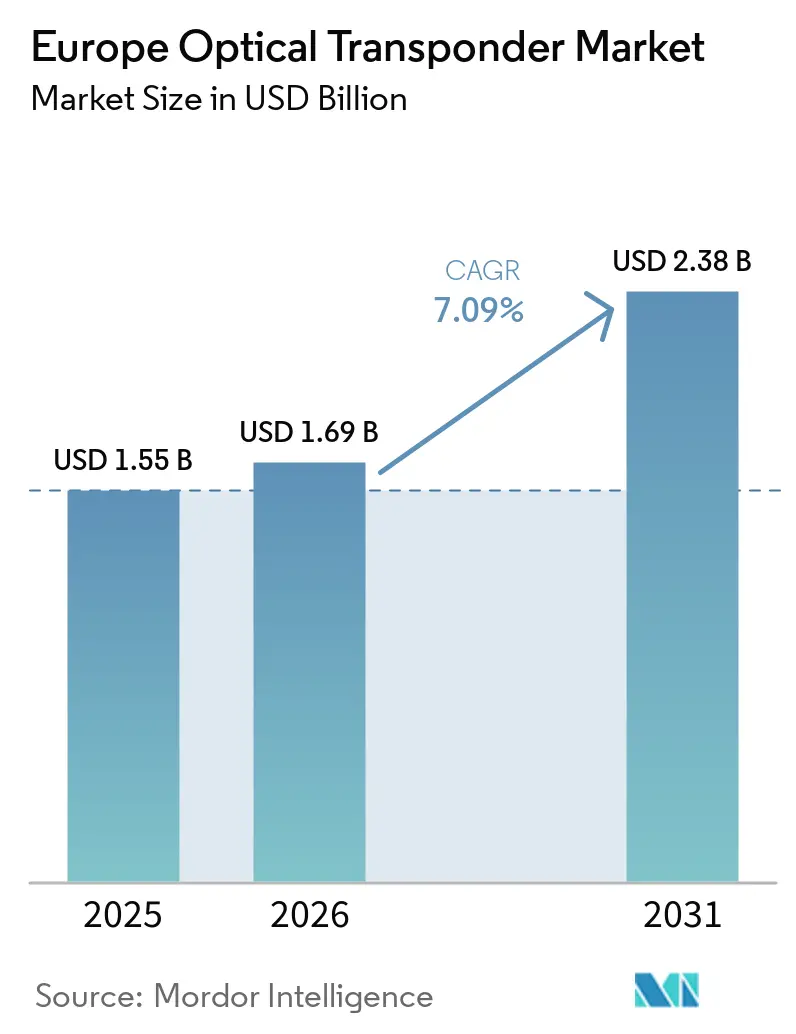
Base Year Market Size (2025) | USD 1.55 Billion |
Market Size (2026) | USD 1.69 Billion |
Market Size (2031) | USD 2.38 Billion |
Growth Rate (2026 - 2031) | 7.09 % |
Market Concentration | Medium |
Major Players*Disclaimer: Major Players sorted in no particular order
Image © Vijeron Intelligence. Reuse requires attribution under CC BY 4.0.
Image © Vijeron Intelligence. Reuse requires attribution under CC BY 4.0.
Section 2
Europe Optical Transponder Market Analysis by Vijeron IntelligenceThe Europe Optical Transponder Market size is expected to grow from USD 1.55 billion in 2025 to USD 1.69 billion in 2026, and is forecast to reach USD 2.38 billion by 2031, at a 7.09% CAGR over 2026-2031. Demand is being supported by new data center links, standalone 5G transport upgrades, and the replacement of older SDH and SONET equipment with flexible-grid optical transport platforms. Large cloud operators are increasingly purchasing optical equipment directly, thereby changing the traditional role of telecommunications carriers in procurement and service delivery. European security reviews of Chinese network equipment could spur demand for alternative coherent platforms, although national requirements can delay final purchasing decisions. Component supply remains an important constraint because advanced coherent processors and photonic parts are needed for higher-speed systems. The European optical transponder market, therefore, combines strong demand from digital infrastructure investment with a more selective supply environment for advanced equipment.
Key Report Takeaways
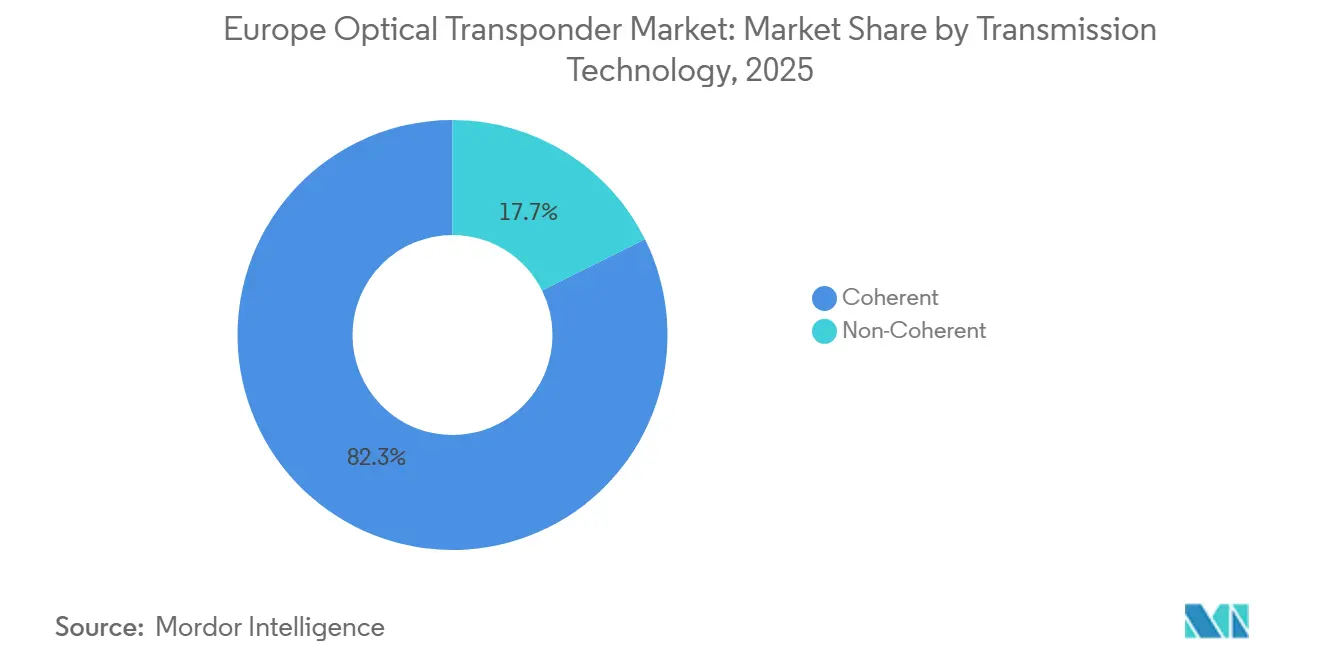
- By transmission technology, coherent technology held 82.34% of the Europe Optical Transponder Market share in 2025, and is projected to expand at a 7.72% CAGR through 2031.
- By data rate, the above 100 Gbps to 400 Gbps tier accounted for 45.19% of the Europe optical transponder market share in 2025, while the above 800 Gbps tier is projected to expand at a 12.81% CAGR through 2031.
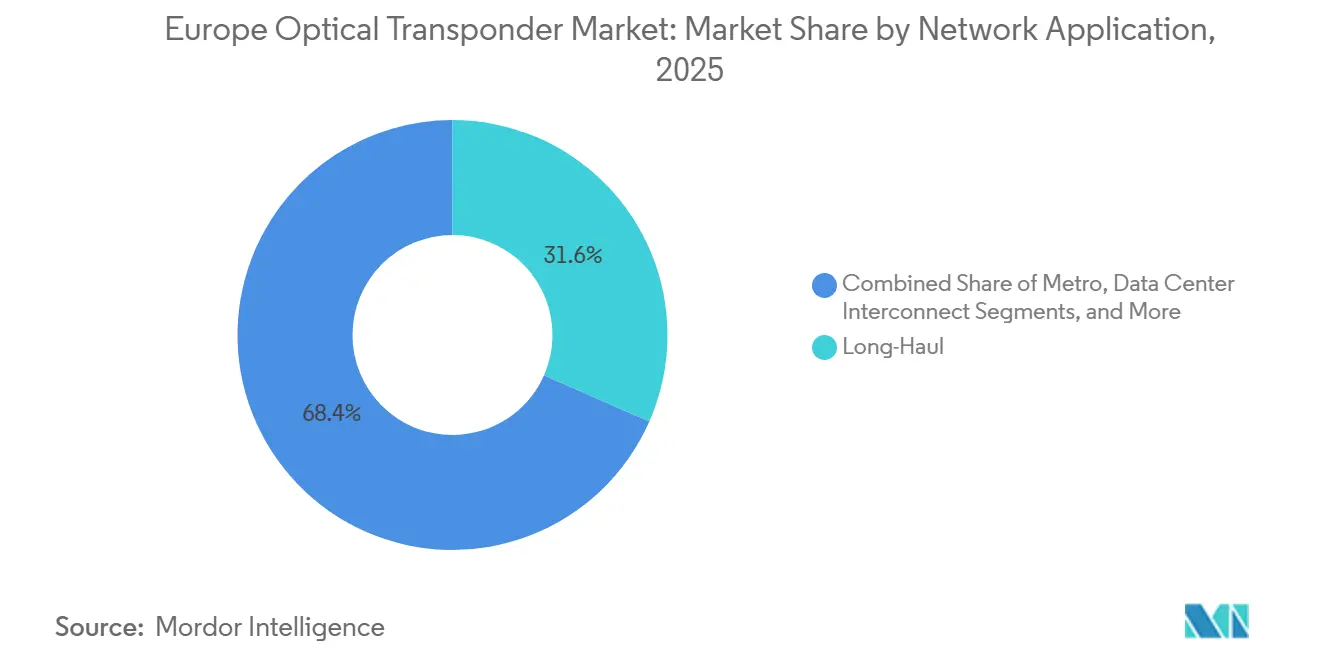
- By network application, long-haul applications held 31.59% of the Europe optical transponder market share in 2025, while data center interconnect is projected to advance at a 9.65% CAGR through 2031.
- By end-user, telecommunications service providers accounted for 60.10% of the European optical transponder market share in 2025, while cloud and hyperscale data center operators are projected to expand at a 9.85% CAGR through 2031.
- By country, Germany held 23.39% of the Europe optical transponder market share in 2025, while Spain is projected to record a 9.55% CAGR through 2031.
Note: Market size and forecast figures in this report are generated using Vijeron Intelligence’s proprietary estimation framework, updated with the latest available data and insights as of January 2026.
Section 3
Europe Optical Transponder Market Trends and InsightsDrivers Impact Analysis*
Driver | (~) % Impact on CAGR Forecast | Geographic Relevance | Impact Timeline |
AI and Hyperscaler Data Center Interconnect Expansion | +2.0% | Germany, Netherlands, Ireland, France, broadening to Spain and Poland | Short term (≤ 2 years) |
5G Standalone Backhaul and Mid-Haul Capacity Upgrades | +1.5% | Germany, UK, France, Spain, with spillover to Italy and the Nordics | Medium term (2-4 years) |
Legacy SDH and SONET Replacement by Flexible-Grid Coherent OTN | +1.0% | Pan-European, with the strongest activity among Western and Southern European incumbents | Medium term (2-4 years) |
Cross-Border Fiber and Submarine Cable Resilience Investment | +0.8% | Central and Eastern Europe, the Baltics, the Mediterranean, and Baltic Sea corridors | Medium term (2-4 years) |
Distributed AI Infrastructure Requiring 800ZR+ Interconnects | +0.5% | Germany, UK, France, expanding to the Nordics and Spain | Short term (≤ 2 years) |
European Digital Sovereignty and Secure Optical Infrastructure Programs | +0.3% | EU-wide, concentrated in France, Germany, the Netherlands, and Spain | Long term (≥ 4 years) |
Source: Vijeron Intelligence |
AI and Hyperscaler Data Center Interconnect Expansion
AI training systems increasingly use multiple data centers rather than a single site, increasing the need for fast, direct connections between facilities. These distributed workloads require high-capacity, coherent transponders that can transport data across campus, metro, and regional routes with low delay. Nokia reported optical network revenue of EUR 821 million (USD 959 million) in the first quarter of 2026, with demand from hyperscale data center customers supporting performance. This demand gives equipment vendors a larger direct customer base, since cloud providers can procure optical systems without using a carrier-led tender. The European optical transponder market benefits when operators expand major data center clusters in Frankfurt, Amsterdam, Paris, Dublin, and other connected locations.
5G Standalone Backhaul and Mid-Haul Capacity Upgrades
Standalone 5G networks require stable, low-latency transport between radio sites, edge systems, and core networks. Older SDH and multiservice transport platforms were not designed to meet the timing and capacity requirements of these links. Dense urban fiber networks can support fixed broadband and mobile backhaul on shared routes, improving the use of existing infrastructure. This makes coherent wavelength systems more useful for operators upgrading both fiber access and 5G transport simultaneously. The Europe optical transponder market gains from this overlap because each transport upgrade can support more than one network service.
Legacy SDH and SONET Replacement by Flexible-Grid Coherent OTN
Many incumbent operators still have aging SDH and related transport systems installed during earlier network investment cycles. Expiring support contracts, limited spare parts, and higher power use are encouraging a move toward modern optical transport network platforms. New flexible-grid coherent systems enable more capacity to be deployed over existing fiber while supporting different services on the same network. They can also provide the timing precision needed for standalone 5G synchronization, linking the replacement cycle to broader mobile upgrades. The European optical transponder market is supported by operators who combine equipment retirement with capacity, automation, and energy-efficiency objectives.
Cross-Border Fiber and Submarine Cable Resilience Investment
New cross-border fiber routes are increasing the need for equipment at both ends of each connection and across the route itself. EXA Infrastructure launched Project Visegrad in September 2025 to connect Warsaw, Poznan, Prague, Bratislava, and Budapest with its backbone in Berlin, Frankfurt, and Vienna.[1]EXA Infrastructure, “EXA Infrastructure Launches Project Visegrád: Largest Cross-Border Fibre Backbone Deployment in Central Europe in 25 Years,” GÉANT CONNECT Online, connect.geant.org The European Commission selected 56 projects for up to EUR 389 million (USD 416 million) under the CEF-Digital program in November 2025, including terrestrial backbones, submarine cables, EuroQCI links, and 5G corridors.[2]European Commission, “56 Projects Selected for Up to EUR 389 Million Under 4th CEF-Digital Calls,” HaDEA, hadea.ec.europa.eu Diverse routes improve network resilience, but they also require operators to install capacity on new and existing paths. This creates procurement opportunities for the European optical transponder market in Central, Eastern, and Southern Europe.
Restraints Impact Analysis*
Restraint | (~) % Impact on CAGR Forecast | Geographic Relevance | Impact Timeline |
Specialized Coherent DSP and Photonic Packaging Dependence | -1.2% | Global supply chain, affecting all European markets | Short term (≤ 2 years) |
Fragmented National Qualification and Security Reviews | -0.8% | Germany, France, the United Kingdom, the Netherlands, with variation across EU member states | Long term (≥ 4 years) |
High Integration Cost Across Legacy and Open Optical Networks | -0.5% | Pan-European, especially for operators with multi-vendor and multi-generation networks | Medium term (2-4 years) |
Skilled Fiber-Deployment Labor Shortages | -0.3% | Rural and secondary markets across Eastern and Southern Europe | Medium term (2-4 years) |
Source: Vijeron Intelligence |
Specialized Coherent DSP and Photonic Packaging Dependence
Advanced coherent systems rely on specialized digital signal processors, indium phosphide photonic components, and high-capacity manufacturing processes. Availability constraints can delay equipment deliveries even when operators have committed funding for new routes. The constraint is most visible for 800G and future 1.6 Tbps products, which need advanced components and packaging. Nokia completed its USD 2.3 billion acquisition of Infinera on February 28, 2025, adding Infinera’s indium phosphide photonic integrated circuit capability to its optical networking business. The European optical transponder market remains exposed to supply conditions that are determined well beyond the region’s network operators.
Fragmented National Qualification and Security Reviews
Network vendors must meet different qualification, cybersecurity, and procurement requirements across European countries. These differences can lengthen project planning, especially when a route crosses several national jurisdictions. Security decisions involving high-risk vendors can also leave operators uncertain about the timing and scope of replacement programs. The resulting delays affect equipment orders because operators may wait until compliance requirements are clear. The European optical transponder market faces this restraint most strongly in large, multi-country network programs where approvals must align across several authorities.
*Our forecasts treat driver/restraint impacts as directional, not additive. The impact forecasts reflect baseline growth, mix effects, and variable interactions.
Section 4
Segment AnalysisBy Transmission Technology: Coherent Platforms Lead Network Modernization
Coherent technology held 82.34% of the Europe optical transponder market share in 2025, reflecting its broad use across metro, long-haul, and submarine routes. The technology carries more data over each fiber pair and is suited to routes where capacity and reach matter most. RETN stated in July 2026 that 50% of its IP/MPLS backbone traffic was carried over 400G coherent ZR and ZR+ infrastructure.[3]RETN, “RETN Migrates 50% of Its IP/MPLS Traffic Onto 400G ZR+ Optics,” RETN News, retn.net The deployment covered backbone links from 300 km to 950 km and showed that coherent pluggables had moved from trials into standard network design. Non-coherent equipment remained relevant for short connections and legacy access networks where the additional processing of coherent systems was not needed. Its role was narrower because more access and metro networks were also moving toward higher-capacity architectures.
The segment is projected to expand at a 7.72% CAGR through 2031, the fastest rate within this technology grouping. Coherent Corp. introduced a dual-laser 100G ZR QSFP28 module for bidirectional applications in September 2025, extending coherent options into access environments.[4]Coherent Corp., “Coherent Announces Industry’s First 100G ZR QSFP28 for Bi-Directional Applications,” GlobeNewswire, globenewswire.com This development suggested that the economic boundary between coherent and direct-detect equipment was moving toward shorter links. Nokia presented new coherent product families at OFC 2026 for campus, metro, data center interconnect, long-haul, and subsea use. The product range addressed different distances and capacity needs rather than relying on one system design. The European optical transponder market will continue to favor coherent technology as operators seek a common transport approach across several network layers.
Image © Vijeron Intelligence. Reuse requires attribution under CC BY 4.0. By Data Rate: 400G Retains the Largest Installed Role While 800G+ Advances
The above-100 Gbps to 400 Gbps tier accounted for 45.19% of the European optical transponder market in 2025. This tier remained the practical backbone for established long-haul and large metro routes because 400G equipment is widely deployed and familiar to operators. The up to 100 Gbps range continued to serve legacy access, enterprise edge, and lower-capacity connections. The above 400 Gbps to 800 Gbps tier supported customers that needed an upgrade but were not yet ready to redesign their networks around native 800G links. Arelion completed a field trial in February 2025 that carried 800G ZR+ IP traffic across 1,069 km between Stockholm and Hamburg. The trial reported a 66% reduction in capital expenditure and a 95% reduction in operating expenditure compared with the earlier technology used on that route.
The above 800 Gbps tier is projected to grow at a 12.81% CAGR through 2031, making it the fastest-growing data-rate segment. Higher-speed equipment is being adopted where AI workloads require more capacity among data centers and between regional hubs. Marvell introduced the COLORZ 1600, a 1.6T ZR and ZR+ pluggable, and a new 800G pluggable in March 2026. The products were designed for metro AI interconnects up to 1,000 km at 800G and regional links up to 2,000 km at 600G. The European optical transponder market size for higher-rate equipment is being shaped by data center architecture, power efficiency, and the readiness of existing fiber systems. Demand for 800G+ systems will depend on the availability of compatible routers, line systems, and optical components.
By Network Application: Long-Haul Revenue Is Established While DCI Accelerates
Long-haul applications accounted for 31.59% of the European optical transponder market share in 2025. Continental backbone routes connect national networks, data centers, internet exchanges, and cable landing stations, giving this application a large installed base. GÉANT demonstrated 400G transmission across 3,403 km on its live European network route in 2025 using Cisco and Acacia coherent pluggable optics. The route ran through London, Paris, Geneva, Frankfurt, Amsterdam, and back to London without standalone transponders or regeneration equipment. This result showed how pluggable coherent technology can alter the design of some long-distance systems. Metro and submarine routes also require substantial optical capacity because they link dense local traffic and international cable networks.
Data center interconnect is projected to expand at a 9.65% CAGR through 2031, faster than the other network applications identified in the report. Cloud providers need direct links among facilities as their computing and storage networks expand across multiple sites. DE-CIX connected Deutsche Glasfaser to DE-CIX Frankfurt through an 800 GbE port in November 2025 using Nokia 800G-ZR+ optics integrated into Nokia IP routers. The connection lifted Deutsche Glasfaser’s aggregate capacity at DE-CIX Frankfurt above 1.6 Tbit/s. The European optical transponder market is supported as interconnection shifts from bundles of lower-rate modules to native, single-wavelength 800G capacity. Other applications include utility communications and private long-distance enterprise links, which use optical transport for secure and predictable connectivity.
Image © Vijeron Intelligence. Reuse requires attribution under CC BY 4.0. By End-User: Telecommunications Providers Hold the Largest Base While Cloud Operators Gain Pace
Telecommunications service providers accounted for 60.10% of the European optical transponder market size in 2025. Their networks carry broad fixed and mobile traffic, and they remain responsible for many national backbone and access upgrades. Nokia secured a multiyear contract with Orange Belgium in July 2026 to modernize the operator’s transport infrastructure with a converged optical network. Nokia also launched an 800G-ready core and transport platform with KPN in the Netherlands during January 2026. These deployments showed how providers are bringing fixed and mobile transport onto fewer, more flexible optical platforms. Government and defense customers also require secure transport layers for public infrastructure and quantum communications programs.
Cloud and hyperscale data center operators are projected to expand at a 9.85% CAGR through 2031, the fastest rate among end-user groups. These customers increasingly buy systems directly from vendors rather than relying only on carrier-managed transport. Direct purchasing changes the commercial relationship because equipment suppliers can work with the end user who plans the data center fabric. Enterprises such as financial firms, utilities, and healthcare operators use private optical networks for sensitive data flows, operational systems, and low-latency links. Their total requirement is smaller than that of telecommunications providers, but their needs can be important in Germany and the UK. The European optical transponder market gains another group of buyers as cloud operators build their own inter-data-center routes and expand their edge locations.
Section 5
Geography Analysis
Germany held 23.39% of the European optical transponder market share in 2025, supported by Frankfurt’s role as a major data exchange hub and national fiber and 5G upgrades. DE-CIX reported that its Frankfurt exchange handled 45 exabytes of traffic during 2024, 13% more than the prior year. The exchange’s traffic volume supports continued demand for capacity at carrier, data center, and interconnection locations. Colt began using Cisco 800G ZR+ coherent optics in its production AS8220 network in mid-2025, following a Frankfurt-Munich trial over 667 km. The project doubled capacity per link and reduced power consumption by 33%, highlighting the operating case for higher-rate optics on established routes.
The UK and France remained important contributors to the European optical transponder market due to mobile transport upgrades, national backbone requirements, and submarine cable connections. UK operators continued investment in transport while upgrading mobile networks and adjusting equipment plans in response to security restrictions. France benefits from cable landing locations in Normandy and Brittany, where submarine systems connect with terrestrial transport networks. These handoff points require coherent capacity to move traffic from cables into national and international routes. The two countries also illustrate different sources of demand, with the UK centered on network modernization and France supported by its connection to international cable infrastructure.
Italy and Spain are smaller contributors today, but both are adding demand through open-access fiber, mobile upgrades, and edge infrastructure. ADTRAN was selected by FiberCop in January 2026 for a nationwide metro optical transport rollout in Italy using open optical technology and 100ZR coherent pluggables. Spain is projected to register a 9.55% CAGR through 2031, the fastest rate in the European optical transponder market, following Telefonica's copper network shutdown in May 2025 and Nokia's selection for 17 Spanish edge data center nodes. The Rest of Europe includes the Nordics, Benelux, Central and Eastern Europe, and the Balkans, where Project Visegrád and the 150 km Serbia-Bosnia and Herzegovina 800G route are widening the network footprint.
Section 6
Competitive Landscape
The European optical transponder market has a moderately consolidated system-vendor structure, with Nokia, Ciena, Huawei, ZTE, and Cisco holding leading global revenue positions in 2025. Nokia’s acquisition of Infinera added scale in optical networking and access to indium phosphide photonic integrated circuit production. This combination strengthened its position in long-haul, subsea, and major European operator accounts. Ciena remained focused on cloud and data center interconnect opportunities, while Ekinops offered a European alternative for operators seeking to diversify their vendor base.
Nokia’s agreement with Orange Belgium illustrates how large vendors are pursuing integrated transport modernization projects. The program uses the 1830 Photonic Service Switch platform, WaveSuite automation, and thin transponders to support converged network requirements. Ekinops signed a 10-year framework agreement with Proximus in July 2026 for the NEURON project across more than 600 sites in Belgium. The agreement covers 800 Gbps capacity and a path toward a future 1.6 Tbit/s upgrade. ADTRAN’s FiberCop win in Italy showed that open optical transport is also being selected for national wholesale fiber networks.
Competition is also moving toward components, pluggables, and photonic integration. Marvell’s 1.6T ZR and ZR+ announcement placed higher-speed pluggable technology at the center of data center interconnect planning. Coherent Corp. stated that it planned to unveil its PhotonLink platform at ECOC in September 2026, covering generation, transmission, and detection across the optical signal chain. The European optical transponder market could see component suppliers gain more influence as customers adopt modular network designs. European public investment in microelectronics and communication technologies may also support local photonics capability over time.
Europe Optical Transponder Industry Leaders* Nokia Corporation
- Ciena Corporation
- Huawei Technologies Co., Ltd.
- ZTE Corporation
- Cisco Systems, Inc.
- *Disclaimer: Major Players sorted in no particular order
Image © Vijeron Intelligence. Reuse requires attribution under CC BY 4.0.
Section 7
Recent Industry Developments* August 2026: Coherent Corp. announced it will unveil its PhotonLink platform at the European Conference on Optical Communications in September 2026, covering integrated optics across the complete signal chain from light generation through transmission and detection, targeting co-packaged optics, near-package optics, and next-generation data center architectures, marking a strategic expansion from transceiver components into integrated platform solutions.
- July 2026: Nokia secured a multiyear contract from Orange Belgium to modernize its national transport infrastructure into a converged optical network using the 1830 Photonic Service Switch platform, Nokia's AI-powered WaveSuite automation software, and thin transponders, marking the first deployment of the 1830 PSS for core optical transport within an Orange affiliate and supporting convergence of 5G, AI, and quantum-safe requirements.
- July 2026: Ekinops signed a 10-year framework agreement with Proximus for the NEURON (Next-Generation Enhanced Uniform Reliable Optical Network) project, covering WDM-based optical equipment and services for more than 600 sites across Belgium at 800 Gbps capacity, with a WDM platform preconfigured for a future 1.6 Tbit/s upgrade. The first commercial deployment was scheduled for the fourth quarter of 2026.
- March 2026: Marvell Technology unveiled the industry’s first 1.6T ZR and ZR+ pluggable, COLORZ 1600, powered by the Electra 2nm coherent DSP, and a new generation 800G pluggable using the Libra 2nm DSP. The products supported metro AI interconnects up to 1,000 km at 800G and regional links up to 2,000 km at 600G, with customer sampling targeted for the second half of 2026.
Section 8
Table of Contents for Europe Optical Transponder Industry Report1. INTRODUCTION
- 1.1 Study Assumptions and Market Definition
- 1.2 Scope of the Study
- RESEARCH METHODOLOGY
- EXECUTIVE SUMMARY
- MARKET LANDSCAPE
- 4.1 Market Overview
- 4.2 Market Drivers* 4.2.1 AI and Hyperscaler Data Center Interconnect Expansion
- 4.2.2 5G Standalone Backhaul and Mid-Haul Capacity Upgrades
- 4.2.3 Legacy SDH/SONET Replacement by Flexible-Grid Coherent OTN
- 4.2.4 Cross-Border Fiber and Submarine Cable Resilience Investment
- 4.2.5 Distributed AI Infrastructure Requiring 800ZR+ Interconnects
- 4.2.6 European Digital Sovereignty and Secure Optical Infrastructure Programs
- 4.3 Market Restraints* 4.3.1 Specialized Coherent DSP and Photonic Packaging Dependence
- 4.3.2 Fragmented National Qualification and Security Reviews
- 4.3.3 High Integration Cost Across Legacy and Open Optical Networks
- 4.3.4 Skilled Fiber-Deployment Labor Shortages
- 4.4 Industry Value Chain Analysis
- 4.5 Regulatory Landscape
- 4.6 Porter's Five Forces Analysis* 4.6.1 Threat of New Entrants
- 4.6.2 Bargaining Power of Suppliers
- 4.6.3 Bargaining Power of Buyers
- 4.6.4 Threat of Substitutes
- 4.6.5 Competitive Rivalry
- 4.7 Impact of Macroeconomic Factors on the Market
- MARKET SIZE AND GROWTH FORECASTS (VALUE)
- 5.1 By Transmission Technology* 5.1.1 Coherent
- 5.1.2 Non-Coherent
- 5.2 By Data Rate* 5.2.1 Up to 100 Gbps
- 5.2.2 Above 100 Gbps to 400 Gbps
- 5.2.3 Above 400 Gbps to 800 Gbps
- 5.2.4 Above 800 Gbps
- 5.3 By Network Application* 5.3.1 Metro
- 5.3.2 Long-Haul
- 5.3.3 Data Center Interconnect
- 5.3.4 Submarine
- 5.3.5 Other Network Applications
- 5.4 By End-User* 5.4.1 Telecommunication Service Providers
- 5.4.2 Cloud and Hyperscale Data Center Operators
- 5.4.3 Enterprises
- 5.4.4 Government and Defense
- 5.4.5 Other End-Users
- 5.5 By Country* 5.5.1 Germany
- 5.5.2 United Kingdom
- 5.5.3 France
- 5.5.4 Italy
- 5.5.5 Spain
- 5.5.6 Rest of Europe
- COMPETITIVE LANDSCAPE
- 6.1 Market Concentration
- 6.2 Strategic Moves
- 6.3 Market Share Analysis
- 6.4 Company Profiles (includes Global Level Overview, Market Level Overview, Core Segments, Financials as available, Strategic Information, Market Rank/Share, Products and Services, Recent Developments)* 6.4.1 Nokia Corporation
- 6.4.2 Huawei Technologies Co., Ltd.
- 6.4.3 Ciena Corporation
- 6.4.4 Cisco Systems, Inc.
- 6.4.5 ADTRAN Holdings, Inc.
- 6.4.6 Ekinops S.A.
- 6.4.7 ZTE Corporation
- 6.4.8 Fujitsu Limited
- 6.4.9 NEC Corporation
- 6.4.10 Ribbon Communications Inc.
- 6.4.11 Coherent Corp.
- 6.4.12 Lumentum Holdings Inc.
- 6.4.13 Marvell Technology, Inc.
- 6.4.14 Broadcom Inc.
- 6.4.15 Sumitomo Electric Industries, Ltd.
- 6.4.16 Mitsubishi Electric Corporation
- 6.4.17 FiberHome Telecommunication Technologies Co., Ltd.
- 6.4.18 UfiSpace Co., Ltd.
- 6.4.19 Edgecore Networks Corporation
- 6.4.20 Smartoptics Group ASA
- MARKET OPPORTUNITIES AND FUTURE OUTLOOK
- 7.1 White-Space and Unmet-Need Assessment
Section 9
Europe Optical Transponder Market Report ScopeThe European optical transponder market revenue is generated through the sale of optical transponders and related transponder-based transmission equipment across data rates ranging from 100 Gbps to above 800 Gbps, supplied to telecommunication service providers, cloud and hyperscale data center operators, enterprises, government and defense organizations, and other end users.
The Europe optical transponder market report is segmented by transmission technology (coherent and non-coherent), data rate (up to 100 Gbps, above 100 Gbps to 400 Gbps, above 400 Gbps to 800 Gbps, and above 800 Gbps), network application (metro, long-haul, data center interconnect, submarine, and other network applications), end-user (telecommunication service providers, cloud and hyperscale data center operators, enterprises, government and defense, and other end-users), and country (Germany, United Kingdom, France, Italy, Spain, and rest of Europe). The market forecasts are provided in terms of value (USD).
By Transmission TechnologyCoherent |
Non-Coherent |
By Data RateUp to 100 Gbps |
Above 100 Gbps to 400 Gbps |
Above 400 Gbps to 800 Gbps |
Above 800 Gbps |
By Network ApplicationMetro |
Long-Haul |
Data Center Interconnect |
Submarine |
Other Network Applications |
By End-UserTelecommunication Service Providers |
Cloud and Hyperscale Data Center Operators |
Enterprises |
Government and Defense |
Other End-Users |
By CountryGermany |
United Kingdom |
France |
Italy |
Spain |
Rest of Europe |
By Transmission Technology | Coherent |
| Non-Coherent |
|---|
By Data Rate | Up to 100 Gbps |
| Above 100 Gbps to 400 Gbps |
|---|
| Above 400 Gbps to 800 Gbps |
| Above 800 Gbps |
By Network Application | Metro |
| Long-Haul |
|---|
| Data Center Interconnect |
| Submarine |
| Other Network Applications |
By End-User | Telecommunication Service Providers |
| Cloud and Hyperscale Data Center Operators |
|---|
| Enterprises |
| Government and Defense |
| Other End-Users |
By Country | Germany |
| United Kingdom |
|---|
| France |
| Italy |
| Spain |
| Rest of Europe |
Section 10
Key Questions Answered in the ReportWhat is the Europe optical transponder market size? The Europe optical transponder market was valued at USD 1.55 billion in 2025 and is estimated at USD 1.69 billion in 2026. It is expected to reach USD 2.38 billion by 2031.
What CAGR is forecast for optical transponders in Europe through 2031? The forecast CAGR is 7.09% for 2026-2031. Demand is linked to data center interconnects, 5G transport upgrades, and modernization of older optical networks.
Which transmission technology leads European optical transport deployments? Coherent technology led with 82.34% share in 2025. It is also the faster technology segment, with a projected 7.72% CAGR through 2031.
Why are 800G and higher optical systems gaining demand in Europe? AI-related data center links need greater capacity across metro and regional routes. The above 800 Gbps segment is projected to record a 12.81% CAGR through 2031.
Which end users are driving demand for optical transponders? Telecommunications service providers held 60.10% share in 2025. Cloud and hyperscale operators are expected to expand faster, at a 9.85% CAGR through 2031.
Which European country is projected to expand fastest through 2031? Spain is projected to record a 9.55% CAGR through 2031, supported by fiber transition activity and edge data center development.